
Picture an accounts clerk. An email that seems to come from a regular supplier gives new bank details, and the clerk pays the next invoice, 48,000 dollars, into that account. The sender knew the email was false, so this is fraud by false representation. The fraud detection and prevention guide covers the controls that stop it.
What is fraud?
Fraud is a lie, a concealment or an abuse of trust used to gain something or make someone lose it. The UK and US definitions both turn on dishonesty and intent.
Section 2 of the Fraud Act 2006 makes it an offense to dishonestly make a false representation intending "to make a gain for himself or another, or to cause loss to another or to expose another to a risk of loss". A representation counts when it is submitted "to any system or device", so a lie typed into a bank's online form to get money can be fraud.
In the United States, the wire fraud statute, 18 U.S.C. 1343, reaches any "scheme or artifice to defraud" carried out by wire, radio or television. Fraudulent activities are the acts in such a scheme.
What are the elements of fraud?
In US civil law, fraud by intentional misrepresentation has five key features (Cornell Wex, "fraud", last reviewed September 2026):
- A false statement of fact.
- Knowledge that it was false, or reckless disregard for the truth.
- Intent that someone rely on it.
- Reasonable reliance by the victim.
- Harm caused by the reliance.
UK criminal law asks for less. The Fraud Act needs no actual loss, only an intended gain, loss or risk of loss, and a dishonest failure to disclose what the law requires counts too (section 3).
Intent is what separates fraud from error. A clerk who keys 4,800 instead of 48,000 by mistake has made an error; a clerk who changes the figure to hide a theft has committed fraud.
What are the types of fraud?
Table 1. Types of fraud, with examples.
| Type | How it works | Typical victim |
|---|---|---|
| Financial fraud | Deceiving investors or lenders, as in a Ponzi scheme | Investors |
| Identity theft | Stealing personal data | Individuals |
| Insurance fraud | Staged or inflated claims | Insurers, policyholders |
| Tax fraud | False returns or hidden income | Governments |
| Banking fraud | Tricks that take account access or funds | Banks, account holders |
| Payroll fraud | Ghost employees or inflated hours | Employers |
| Embezzlement | Taking money or property one was trusted to hold | Employers, public bodies, banks |
| Insider fraud | Staff, contractors or partners abusing trusted access | Employers, their customers |
| Healthcare fraud | Billing for services never performed | Health insurers |
| Online and cyber fraud | Fake shops, social media scams | Online shoppers |
| Procurement fraud | Bid rigging, kickbacks, false invoices | Companies, public bodies |
| Government fraud | False benefit or COVID relief claims | Governments |
| Identity fraud | Accounts or loans opened with stolen or invented identities | Lenders, victims |
| Synthetic identity fraud | Credit taken by a made up person built from real and fake details | Financial institutions |
| Credit card fraud | Spending with skimmed or stolen card data | Card issuers, cardholders |
| Card not present fraud | Paying online, by phone or by mail with stolen card details | Merchants, card issuers |
| Land fraud | Selling property one does not own | Buyers, owners |
| Real estate fraud | Taking a deposit, closing funds or title by deception | Buyers, owners, renters |
| Chargeback fraud | Disputing a real purchase for a refund (friendly fraud) | Merchants |
| Return fraud | Returning stolen, switched, fake or missing goods for a refund | Retailers |
| E-commerce fraud | Stolen card details or false claims at an online checkout | Online stores, shoppers |
| Loan fraud | False income or job details | Lenders |
| Mortgage fraud | A material lie a lender relies on for a home loan | Lenders |
| Bankruptcy fraud | Hiding assets or lying in a bankruptcy case | Creditors |
| Impersonation fraud | Posing as an official, executive or police officer | Individuals, employees |
| Wire fraud | A scheme run by an interstate electronic message | Payers |
| ACH fraud | Unauthorized or falsely induced payments on the US ACH network | Account holders, businesses |
| Check fraud | Forged, altered or counterfeit checks | Banks, businesses |
| Account takeover fraud | Using stolen logins on a real account | Account holders |
| APP fraud | Tricking a customer into authorizing a transfer | Bank customers |
| Transaction fraud | A payment the account holder did not authorize | Cardholders, merchants |
| Business email compromise (BEC) | Emails posing as an executive or supplier that redirect a payment | Companies, finance staff |
| Charity or donation fraud | Fake charities or disaster appeals that collect donations | Donors |
| Romance scams | A fake online relationship built to ask for money | Individuals |
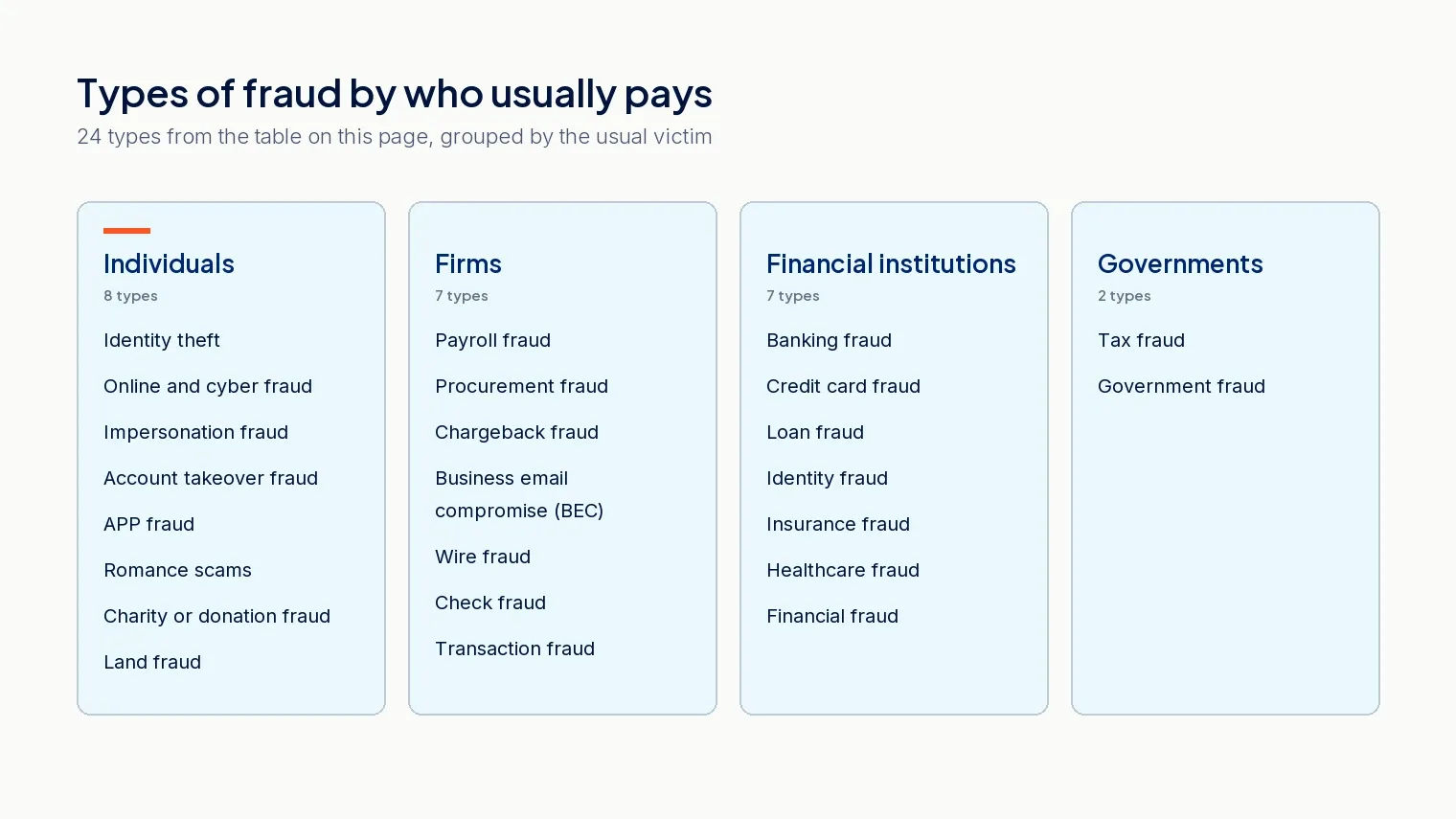
Internal or occupational fraud is committed by staff against their own employer: payroll or check fraud, procurement kickbacks, or theft of cash or stock (asset misappropriation, in ACFE terms). External fraud comes from customers, suppliers or strangers.
Types of financial fraud are the rows aimed at money, credit or investments: investment schemes, loan, card and banking fraud, and false accounts that misstate what a business is worth.
In authorized push payment (APP) fraud, the victim makes the transfer, believing the payee is real, as the clerk did. Transaction fraud is any payment the account holder did not authorize, such as a card used after a data breach. Both show up when the money moves, where payment fraud controls and device and behavior signals work.
What are the three types of fraud?
"When someone asks for the three types of fraud, ask which three they mean: an auditor means the ACFE fraud tree, a payments fraud team means first, second and third party fraud, and a UK prosecutor means the three sections of the Fraud Act," says Burçak Aydın, who has worked in bank and payment institution compliance.
Table 2. Three frames for the three types.
| Frame | The three types | Who uses it | Source |
|---|---|---|---|
| ACFE fraud tree | Asset misappropriation (90% of cases, median loss $100,000), corruption (45%, $150,000), financial statement fraud (6%, $1,000,000) | Auditors, fraud examiners | ACFE, Occupational Fraud 2026, 2,402 cases |
| Party model | First party (the customer lies), second party (a money mule lends an account), third party (a stranger uses a stolen identity) | Bank and payments fraud teams | Industry usage |
| Fraud Act 2006 | False representation (s2), failing to disclose information (s3), abuse of position (s4) | Prosecutors, UK courts | Fraud Act 2006, section 1 |
Auditors also use a two way split: ISA 240 names fraudulent financial reporting and misappropriation of assets.
What is the difference between fraud, a scam, phishing and theft?
A caller posing as a bank's fraud team talks a customer into moving savings to a "safe account". That is a scam. The text message that first collected the login was phishing. A pickpocket would be committing theft.
Fraud is the umbrella term. Theft needs no deception, only dishonest appropriation with the intention of permanently depriving the owner (Theft Act 1968, section 1). Error has no intent (ISA 240, paragraph 2).
Table 3. Fraud vs scam vs phishing vs theft.
| Term | Legal core | Example |
|---|---|---|
| Fraud | Dishonest deception to make a gain or cause a loss | A forged supplier invoice |
| Scam | Fraud in which the victim makes the payment | A "safe account" call |
| Phishing | Deceptive messages that collect logins or card data | A fake bank login page |
| Theft | Dishonestly appropriating another's property to keep it for good | A stolen credit card |
| Error | An unintended misstatement | A mistyped invoice amount |
What are the red flags of fraud?
To identify fraudsters before the loss, look for the fraud triangle's pressure, opportunity and excuse.
In the books. Late manual journal entries, adjustments nobody can explain, resistance to audits. Each keeps a number away from review.
In people. A lifestyle beyond a known salary, an employee who never takes leave, approvals skipped. Leave matters because a colleague then sees the gaps.
In payments and customers. Bank details changed by email, pressure to pay today, a payee name that does not match the account, a counterparty named in news about past fraud.
Each signal feeds a control that raises an alert for an investigator to close or escalate to a suspicious activity report. The fraud detection and prevention guide covers those controls.
How does fraud work?
Most frauds run in four steps.
- Pretext. The fraudster builds a false story, identity or document, or hides a fact the victim needs.
- Channel. The story reaches the victim by email, phone, text, a website or paper.
- Extraction. The victim relies on it and pays, shares a login or approves a loan. That reliance turns the lie into a gain or a loss.
- Laundering. The money moves through mule accounts or exchanges until its source is hard to trace.
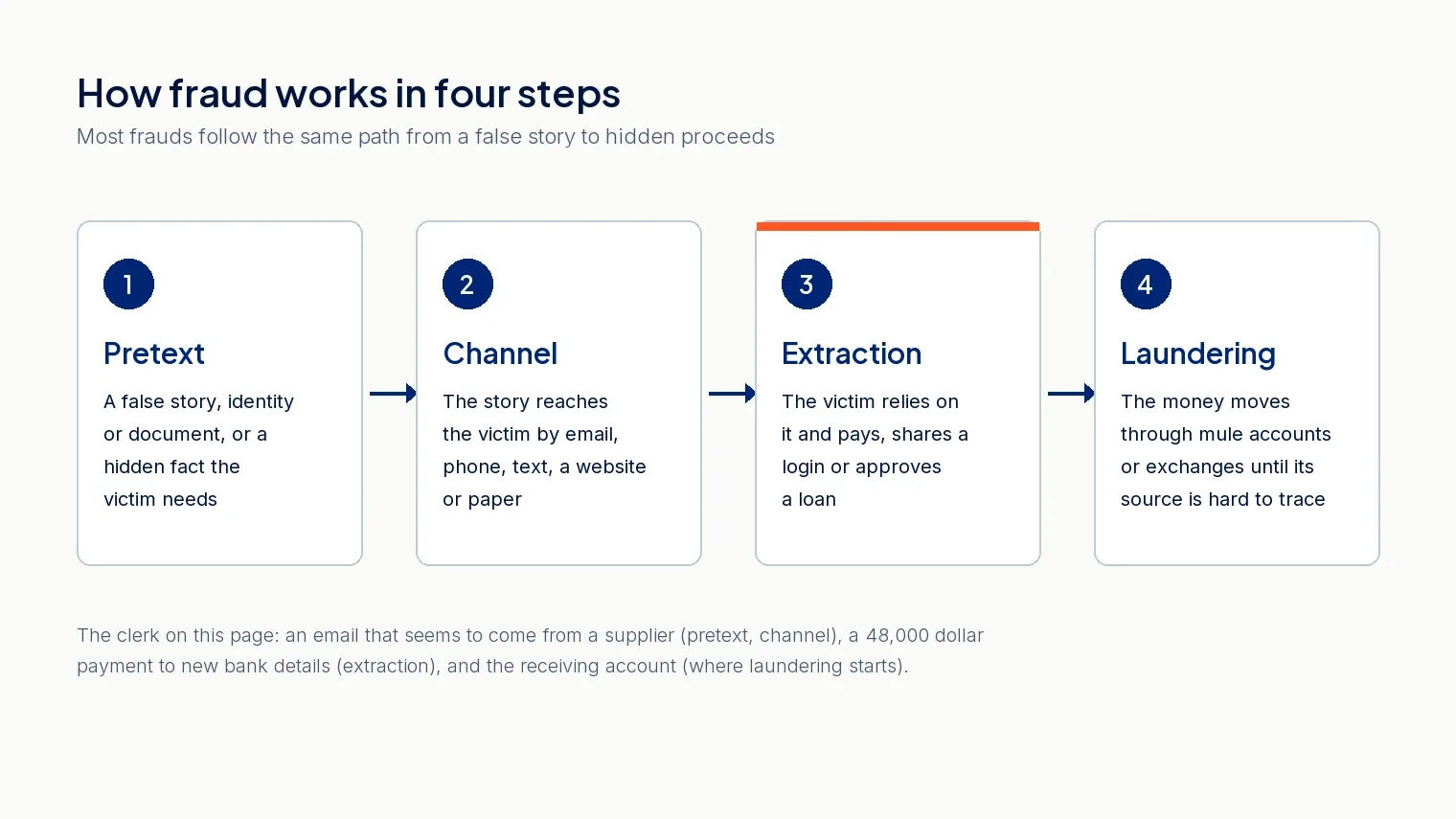
In the clerk's case, the supplier was the pretext, email the channel, the 48,000 dollar payment the extraction and the receiving account the start of laundering.
Why is fraud a growing concern?
"In 2025, the FTC received 3 million fraud reports from consumers, who reported $15.9 billion in losses" (FTC, 25 March 2026). The year before, it had 2.6 million reports and over $12 billion. In England and Wales, fraud victims rose 10 percent to 3.8 million in the year ending March 2026, while incidents, at 4.5 million, showed no statistically significant change (ONS, 23 July 2026). Victims there now report to Report Fraud, which replaced Action Fraud on 4 December 2025 (same ONS bulletin).
The countries with the most scammers shows where those operations are run from.
Where does fraud sit in an AML program?
Picture a payments firm: its fraud team sees refunds cashed out on 30 stolen cards, and its AML team sees the same money leave for a crypto exchange. Fraud, one branch of financial crime, is a predicate offense for money laundering. Directive (EU) 2018/1673 lists it in Article 2(1)(i). The fraud produces the money and laundering hides where it came from, so a fraud case often ends in a suspicious activity report. Running fraud and AML on one record, known as FRAML, joins the two views.
complead runs onboarding, screening, monitoring, investigation and its fraud prevention software on one engine, so each customer carries one risk score rather than one per tool.
What are the legal and financial consequences of fraud?
Fraud carries up to 10 years in prison on indictment in England and Wales (Fraud Act 2006, section 1). US wire fraud carries up to 20 years, or 30 when it affects a financial institution (18 U.S.C. 1343).
Since 1 September 2025, a large organization commits an offense under UK law when an associated person, such as an employee or agent, commits fraud intended to benefit it (Economic Crime and Corporate Transparency Act 2023, section 199), which the Serious Fraud Office can prosecute. Its defense is reasonable prevention procedures (Home Office guidance). Large means two of: more than 250 employees, £36 million turnover or £18 million on the balance sheet (section 201).
Is fraud a crime?
Yes, in the UK and the United States. Cornell Wex notes that fraud "can be both a civil tort and a criminal offense", so a victim can also sue for damages.
What are the major fraud scandals?
A Houston jury convicted Enron's former chief executives Kenneth Lay and Jeffrey Skilling on charges including conspiracy, securities fraud and wire fraud on 25 May 2006 (US Department of Justice).
Table 4. Major fraud scandals.
| Case | Country | Fraud type | What the authority recorded | Source |
|---|---|---|---|---|
| Bernie Madoff Ponzi scheme | USA | Investment fraud | Pleaded guilty to an 11 count information, 12 March 2009; sentenced to 150 years, 29 June 2009 | DOJ, SDNY |
| Theranos | USA | Investor fraud | SEC charge, 14 March 2018: raised more than $700 million from investors through a years long fraud | SEC |
| Patisserie Valerie | UK | Accounting fraud | "Potentially fraudulent accounting irregularities", October 2018; auditor Grant Thornton fined £2.34 million, 27 September 2021 | FRC |
| FTX and Alameda Research | USA, Bahamas | Misuse of customer funds | Convicted by a jury on seven counts, 2 November 2023; sentenced to 25 years, 28 March 2024 | DOJ, SDNY |
Enron and Patisserie Valerie sit on the ACFE's financial statement branch; Madoff and Theranos are false representation in Fraud Act terms. The frame a team works in decides the controls it buys and where it reports.
Related terms
Money laundering. Making criminal proceeds look legitimate (money laundering methods and typologies).
Transaction laundering. A hidden business taking card payments through an approved merchant's account (how transaction laundering works).
Suspicious activity report (SAR). A firm's report of suspected criminal funds to its financial intelligence unit.