
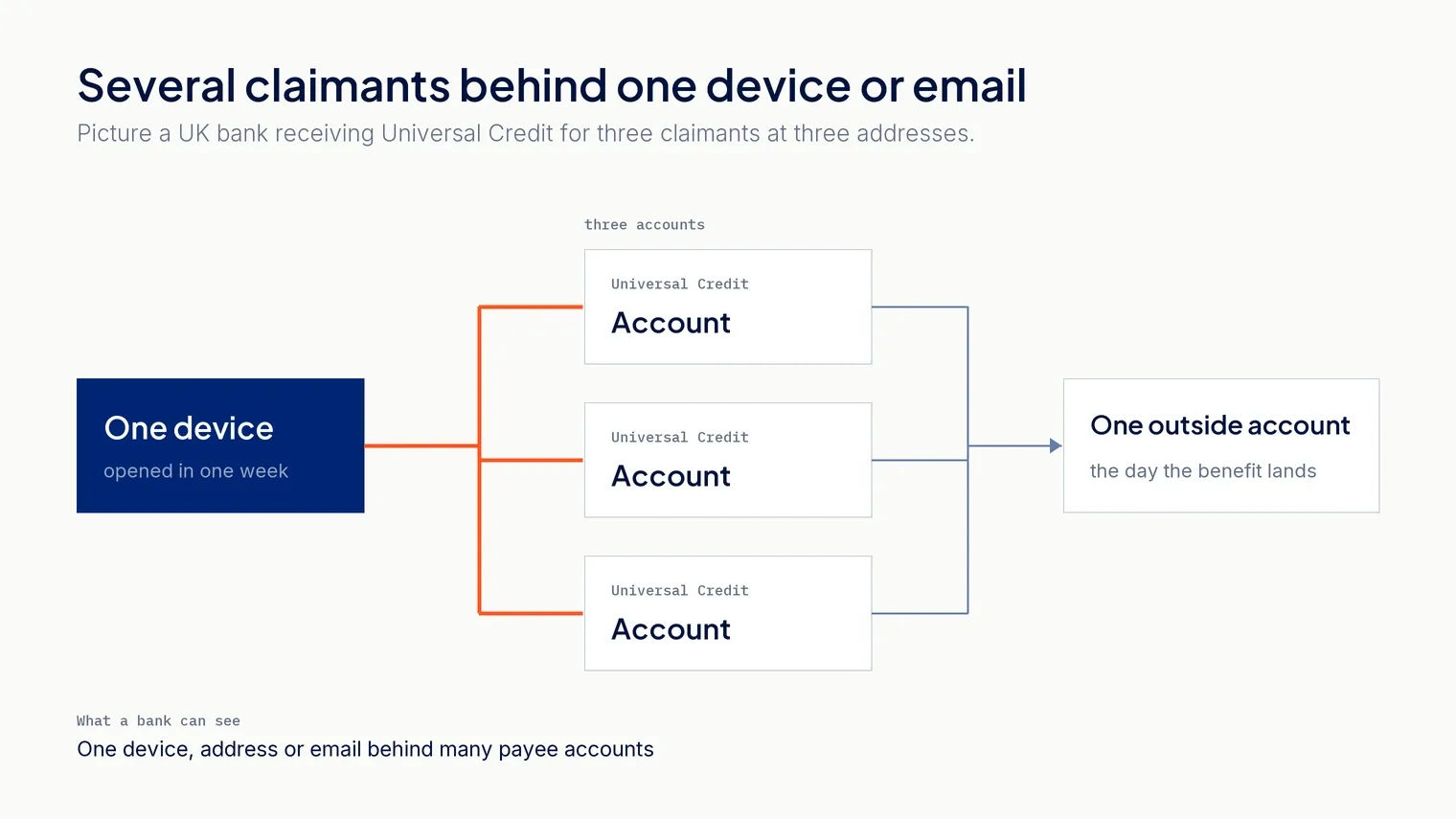
Picture a UK bank receiving Universal Credit for three claimants at three addresses. All three accounts were opened in one week from one device, and each is emptied to one outside account the day the benefit lands. Each claim looks fine alone.
"Organized benefit fraud reuses the same bank accounts, addresses and devices across many claims, so the strongest signal is shared payout details, not the claim itself," says Ufuk Gürdaş, Compliance Specialist.
What is benefit fraud, and what is only an error?
Benefit fraud is fraud against the benefit system, deception with dishonest intent to make a gain. The Department for Work and Pensions (DWP) puts every overpayment it measures down to Fraud, Claimant Error or Official Error (DWP, 19 May 2026).
Table 1. Benefit fraud, claimant error, official error and tax fraud compared.
| Category | Who acts | Definition | Who decides | What can follow |
|---|---|---|---|---|
| Fraud (DWP) | The claimant | Wrong information or an unreported change, when the claimant "could reasonably be expected to understand how this affects their entitlement" and there is "evidence of fraud or a suspicion of fraudulent intent" | DWP, HMRC or a local authority; a court for an offense | Repayment, a penalty or prosecution |
| Claimant Error (DWP) | The claimant | The same, with "no evidence or suspicion of fraudulent intent" | DWP | Repayment of the overpayment |
| Official Error (DWP) | DWP, a local authority or HMRC | "A failure to act, a delay or a mistaken assessment" by the department | DWP | Classed as the department's own error |
| Tax fraud | A taxpayer | Fraudulent intent to pay less tax | HMRC or the IRS | Tax penalties or prosecution |
In plain words, the meaning of benefit fraud is that someone lies or gives false information with the intent to receive benefits or payments they are not legally eligible for. Forgetting to report one month's pay rise is claimant error; hiding a second job for a year fits the Fraud test.
Is benefit fraud the same as tax fraud?
No. Tax fraud keeps from the state revenue it is owed; benefit fraud takes payments the state should not make.
They meet at tax credits. The Sentencing Council lists the Tax Credits Act 2002 among the laws benefit fraud falls under, and the authority that contacts a suspect can be HMRC.
What causes benefit fraud, and how much is lost?
In Universal Credit, undeclared earnings, an undeclared partner and undeclared capital "accounted for over £6 in every £10 overpaid due to Fraud" in DWP's figures for the financial year ending 2026. Fraud overpaid 2.2 percent of spending in Great Britain, £6.8 billion, and Universal Credit fraud ran at 6.8 percent.
Causes differ by benefit. Personal Independence Payment fraud rose to 1.4 percent (£410 million) from 0.4 percent, driven by claimants not reporting that their needs had improved (DWP). Lack of awareness, financial pressure, easy access to personal data, complex applications and weak enforcement may add to it; DWP measures none of them.
In the US, the Department of Labor's inspector general (DOL OIG) says at least $191 billion in pandemic unemployment insurance "could have been improperly paid", a significant portion through fraud (DOL OIG, 5 June 2025).
What are the main types of benefit fraud?
Most rows below are false information, a change kept back or a stolen identity; the last two misuse benefits already paid. Benefits in these examples include unemployment insurance, Universal Credit, SNAP, Housing Benefit and PIP.
Table 2. Types of benefit fraud, with UK and US examples.
| Type | Explanation | Example and source | What a bank can see |
|---|---|---|---|
| Undeclared work or earnings | Works or earns more than declared | Main cause of Universal Credit fraud (DWP); hiding work or earnings (SSA OIG) | Wages or business income beside the benefit |
| Undeclared partner | Hides a partner living at the address | "Living Together" fraud (DWP); hiding living arrangements (SSA OIG) | A joint or linked account with a second income |
| Undeclared capital | Hides savings or assets | "Capital" fraud (DWP); savings or capital (Sentencing Council) | Balances that do not fit a means tested claim |
| Staying abroad | Leaves Great Britain without reporting it | A change to report, in DWP's EVM guidance | Card payments dated in another country |
| False or stolen identity | Fraudsters claim in another person's name | Social Security numbers of deceased people or children under 14 (DOL OIG, March 2020 to April 2022) | Identity details that fail checks at account opening |
| Organized bulk claims | Files many claims through shared details | Claims filed in several states or from suspicious emails (DOL OIG) | One device, address or email behind many payee accounts |
| Payee misuse | Spends a beneficiary's money as their representative | Misuse by a representative payee (SSA OIG) | Benefit for one person spent on another's costs |
| SNAP benefit misuse | A store or claimant uses or transfers SNAP benefits against the rules | Cash for EBT card balances, alleged in the Tacoma case below (indictment release) | Redemptions out of line with the store's size |
On 15 October 2026 the US Attorney's Office for the Western District of Washington said the owner of a Tacoma market, charged with defrauding the US of at least $600,000 in SNAP funds, had been returned from India. He has pleaded not guilty (US Attorney's Office).
What are the warning signs of benefit fraud?
Agencies and banks see different signs.
In the claim, for an agency:
- Earnings the claim leaves out: the main cause of Universal Credit fraud.
- Social Security numbers in a DOL OIG high risk area: claims filed in several states, or numbers of deceased people, federal prisoners, children under 14 or people aged 100 or older.
In the account, for a bank:
- Several claimants behind one device or email: the opening's pattern.
- Weeks of card use abroad: claimants must report leaving Great Britain.
- All out the same day: a possible mule account.
Before onboarding a store that takes SNAP benefits, check the owner's name for fraud news.
What are the consequences of benefit fraud in the UK and US?
Consequences start with repaying the overpayment, and in Great Britain a conviction can reduce or stop benefits for up to 3 years (gov.uk).
Table 3. Benefit fraud offenses and maximum penalties by jurisdiction.
| Jurisdiction | Rule | What it covers | Maximum |
|---|---|---|---|
| Great Britain | Social Security Administration Act 1992, s111A | Dishonest false statement or failure to report a change ("knowingly" in Scotland) | 7 years on indictment |
| Great Britain | SSAA 1992, s112 | Statement or document known to be false | 3 months, a level 5 fine or both |
| Great Britain | SSAA 1992, s115A | Penalty as an alternative to prosecution | 50% of the overpayment, £350 to £5,000 (£350 where no overpayment was made) |
| Northern Ireland | Social Security Administration (Northern Ireland) Act 1992, s105A | Dishonest representation for a benefit | 7 years on indictment |
| Scotland, Scottish benefits | Social Security (Scotland) Act 2018, s71 and s72 | Trying to obtain assistance by deceit; failing to notify a change | 5 years on indictment |
| England, Wales and Northern Ireland | Fraud Act 2006, s1 | Fraud by false representation, failing to disclose or abuse of position | 10 years on indictment |
| US | 42 U.S.C. 408(a) | False statements for Social Security benefits | 5 years; 10 for anyone paid for services in the benefit decision, such as a claimant representative, and for health care providers who submit evidence |
| US | 18 U.S.C. 641 | Theft of public money | 10 years (1 year at $1,000 or less) |
| US | 7 U.S.C. 2024(b) | Unauthorized use, transfer or possession of SNAP benefits | 20 years, a $250,000 fine or both, at $5,000 or more |
The 1992 Act does not extend to Northern Ireland (section 192). The Fraud Act covers only England, Wales and Northern Ireland (section 15).
Scotland also has common law fraud, which the Scottish Government's offense groups list beside statutory fraud (Criminal Proceedings in Scotland, Annex D).
Of the 66,662 cases reported to the US Sentencing Commission in fiscal year 2025, 965 involved government benefits fraud, with a median loss of $144,000 (USSC).
Who detects benefit fraud, and how?
In the 2022 to 2024 National Fraud Initiative, councils matched Housing Benefit records against student loan data and found 1,164 cases with £8.3 million overpaid (NFI report). Its case studies name two councils, Barnet and Luton.
Detecting fraud this way is data matching, which compares "the payroll or benefit records of a body, against other records held by the same or another body". Detection at that scale is social benefits fraud analytics, tools that help detect the links no single record shows. How fraud detection works covers the methods banks use on their own accounts.
As for future trends, AI and machine learning can rank claims for an investigator to decide, and international cooperation brought the Tacoma suspect back from India. Challenges follow from the same data. Access to claimants' accounts stays narrow: "DWP cannot log into your online banking" (DWP guidance).
How does a benefit fraud investigation work?
Gov.uk describes the investigation process in this order:
- Contact: DWP, HMRC, Defence Business Services or the local authority gets in touch.
- Pause: the benefit may be stopped meanwhile.
- Interview: Fraud Investigation Officers may visit, or ask for an "interview under caution", a formal interview that is often recorded.
- Conclusion: they gather the facts and decide on further action.
- Outcome: repayment, a penalty of £350 to £5,000, court, or reduced or stopped benefits.
Where does benefit fraud sit in a bank's fraud and AML program?
Section 78 of the Public Authorities (Fraud, Error and Recovery) Act 2025 (England, Wales and Scotland; fully in force since 2 February 2026) lets DWP require banks and e money issuers to help identify incorrect benefit payments. Under this Eligibility Verification Measure, banks check accounts receiving Universal Credit, Pension Credit or New Style ESA against DWP's "eligibility indicators" and report matches, with balances but never statements or spending. "Any decision about your benefit entitlement or payments will always be made by DWP staff" (DWP, 13 October 2026).
complead, formerly Sanction Scanner, scores bank transfers for fraud before the money moves and keeps fraud and AML on one record.
How do you report benefit fraud or welfare fraud?
In Great Britain, report anonymously on gov.uk or call the National Benefit Fraud Hotline on 0800 854 440 (England and Wales). Northern Ireland has its own hotline at the Department for Communities, 0800 975 6050. Scottish benefits go to Social Security Scotland.
In the US, the SSA inspector general takes reports for Social Security, and the USDA and Labor inspectors general cover SNAP and unemployment insurance. Calls from fake SSA staff are impersonation fraud.
Bank staff who suspect laundering report to the firm's nominated officer, usually the MLRO (Proceeds of Crime Act 2002, s330).
For a bank, the question is which signals are Eligibility Verification Measure matches that DWP's notice requires it to send, and which stay in its own fraud queue.
Related terms
- Money mule. An account holder who receives and passes on criminal money for someone else.
- Identity fraud. Using another person's identity to claim or borrow.
- Insurance fraud. A false claim against an insurer rather than the state.