
Three dates from one US case:
- 9 June 2020. Sheri Reeves opens a bank account. Fraudsters who took over a victim's account later move $565,000 into it.
- November 2024. Having sent the money on by cashier's checks and a crypto ATM, she pleads guilty to aiding bank fraud.
- 27 May 2025. Fifteen months in prison. "Despite being warned by the FBI, Reeves continued," says the sentencing release.
What is a money mule?
Money mules handle the money side of what fraud is: the fraudster deceives the victim, and the mule moves the money away. The FBI's Money Mules page defines a mule as "someone who transfers or moves illegally acquired money on behalf of someone else."
The UK's national risk assessment of 2025 adds the motive: "Money muling is when an individual wittingly or unwittingly (under the guise of a job or as exploitation/coercion) moves criminal funds in exchange for payment/benefits or in response to threats" (paragraph 5.12).
Money muling (often typed money mulling) is the activity, and in Hindi the term is translated word for word as dhan khachchar (धन खच्चर).
Is a money mule the same as a mule account or a money launderer?
No. The mule is the person; the mule account is the bank or crypto account they lend, open or sell; the money launderer organizes the chain. In UK law the gap is small: a mule who only suspects the truth can still be guilty of laundering (Table 3). A drug mule carries drugs.
How does money muling work, from first payment to cash out?
Picture a student who answers a "payments assistant" ad (illustrative numbers):
- Recruit. The recruiter offers 200 dollars to forward "client payments".
- Victims pay. Three strangers, deceived by fake invoices or romance scripts, send 4,250 dollars into the account. The fraud is complete.
- Forward. The student keeps 200 and sends 4,050 to two accounts within the hour.
- Cash out. The money leaves as cash or crypto, and the trail to the victims goes cold.
Steps 2 to 4 are placement, layering and integration, the stages the guide to money laundering methods covers.
When the fake invoices and romance scripts of step 2 run online, the victims are targets of cyber fraud and the mule's account is where their money lands.
"Closing a mule account is only half the job: an FCA review in the UK risk assessment found 25 firms offboarded 194,084 mules from January 2022 to September 2023 but reported only 37 percent to the National Fraud Database, so most could open an account at the next bank with a clean record," says Ufuk Gürdaş, compliance specialist and this entry's reviewer.
Table 1. How money muling works, stage by stage.
| Stage | Criminal | Mule | Laundering stage | Who sees it |
|---|---|---|---|---|
| Recruit | Posts a job or romance offer | Agrees to receive and forward | None yet | Nobody |
| Victims pay | Deceives three victims | Receives 4,250 dollars | Placement | The victim's bank, if the victim calls |
| Forward | Names the next accounts | Keeps 200, sends 4,050 on | Layering | The mule's bank |
| Cash out | Collects cash or crypto | Drops out of the chain | Integration | The bank or crypto firm that pays out |
Which types of money mules do investigators see?
Table 2. The three types of money mules (FBI).
| Type | FBI wording | Typical signs (FBI) | What it can lead to |
|---|---|---|---|
| Unwitting | "unaware they are part of a larger scheme" | Recruited through an online romance or a job offer | Account closure; still illegal, the FBI says |
| Witting | "ignore obvious red flags or act willfully blind" | Warned by bank staff; accounts at several banks | Prosecution; Reeves got 15 months |
| Complicit | "aware of their role and actively participate" | Advertises mule services; recruits other mules | Laundering conspiracy and fraud charges |
What separates the types is what the mule knows. An unwitting mule can become a witting one, the FBI notes, and Reeves, who kept going after an FBI warning, is a witting mule. Complicit mules go further and run funnel accounts that collect from lower level mules.
How do criminals recruit and select money mules?
A post offers work as a "money transfer agent", paid on commission. Europol named that fake job in its 2020 money mule action, noting a turn to social media for recruiting. The UK risk assessment agrees (paragraph 6.2). Criminals also pose as online suitors or lottery officials, the Department of Justice warns.
Which industries and channels do mule recruiters target?
The FBI lists bank accounts, cashier's checks, virtual currency, prepaid cards, money service businesses and crypto kiosks. Business accounts now make up 1 in 5 mule cases reported to Cifas, the risk assessment says (paragraph 5.14). Europol's 2023 action traced mule money to bogus holiday rental listings. Its 2020 action reported some cases tied to COVID.
Who do recruiters target most?
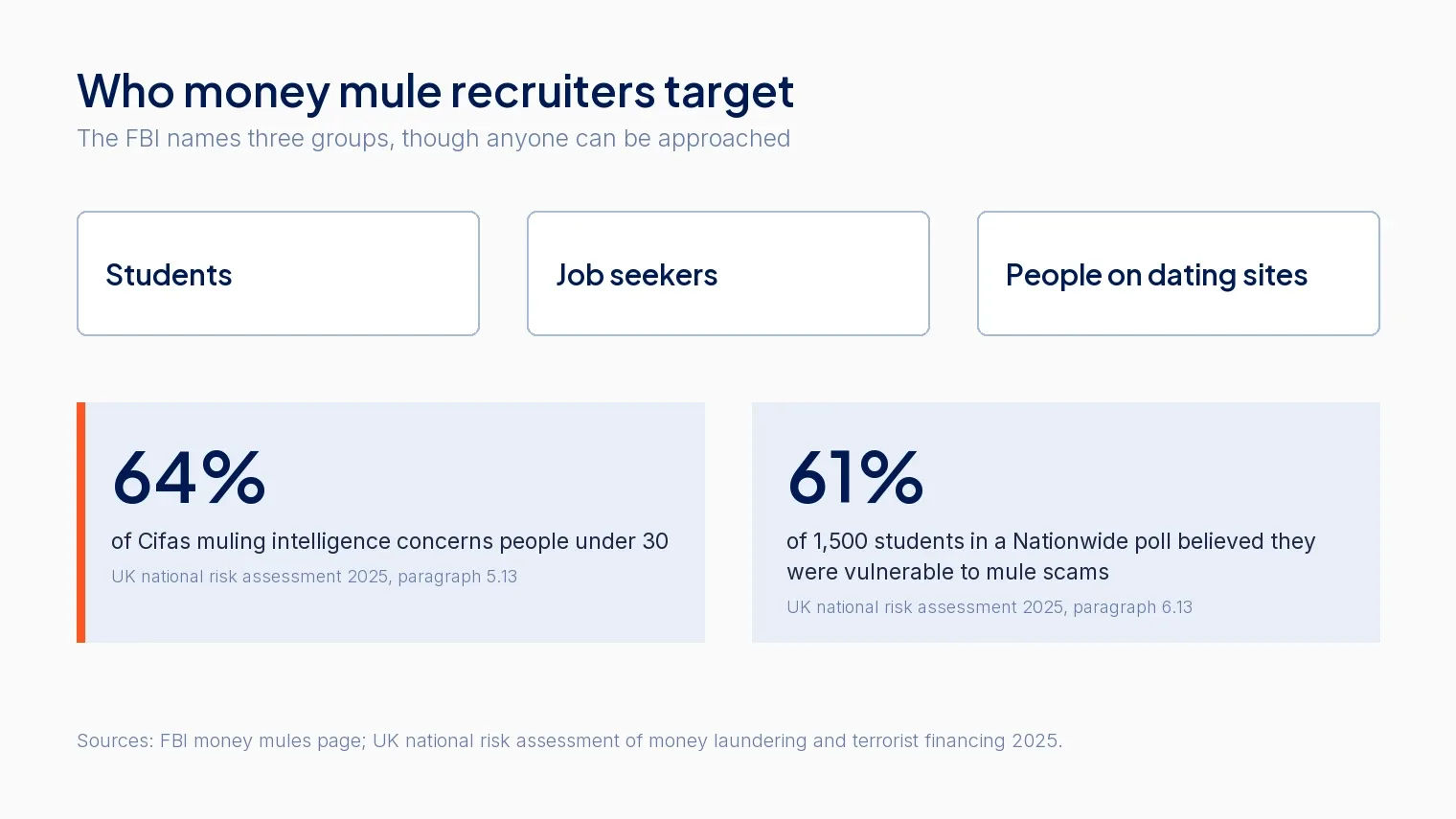
Students, job seekers and people on dating sites, the FBI says, though anyone can be approached. Under 30s account for 64 percent of Cifas muling intelligence (paragraph 5.13). In a Nationwide poll of 1,500 students, 61 percent believed they were vulnerable to mule scams (paragraph 6.13).
What are the red flags of a money mule?
Red flags look different from each side: the person sees the offer, the bank sees the account.
What should a person watch for?
The FBI lists these signs to avoid:
- An unsolicited offer of easy money for little or no effort.
- A request to receive funds and forward them, keeping a portion.
- A new bank account or company opened in your name to receive money.
- An instruction to deposit cash into a crypto kiosk.
Anyone already involved should stop contact, not send on money they still hold, and tell their bank and the police, the DOJ advises. Reports go to IC3 in the US and Report Fraud in England, Wales and Northern Ireland.
What do banks and other businesses watch for?
- Accounts at several banks in one name (FBI).
- Daily transactions of moderate value, in high volume (paragraph 5.13).
- A business account moving larger sums than its trade explains; such accounts draw less suspicion (paragraph 5.14).
- An account opened on someone else's instructions (FBI).
Screening at onboarding sees only the first signal; the second and third appear only once money moves. The money mule detection blog post covers how to detect and check a mule account, and how fraud detection works covers the systems.
What penalties and sanctions can a money mule face?
Table 3. Money mule penalties in the United States, the United Kingdom and India.
| Jurisdiction | Offense | Knowledge test | Maximum prison term | Consequences beyond prison |
|---|---|---|---|---|
| United States | A transaction with crime proceeds (18 U.S.C. 1956); one over $10,000 (18 U.S.C. 1957); wire fraud (18 U.S.C. 1343) | Knowing the property is proceeds of unlawful activity | 20 years (1956); 10 (1957); 20, or 30 if a financial institution is affected (1343) | Damaged credit; liability to repay victims (FBI) |
| United Kingdom | Transferring criminal property (POCA s327); an arrangement that helps another keep it (s328) | "knows or suspects" (s340(3)) | 14 years on indictment (s334) | Account closure; a report to the National Fraud Database |
| India | Money laundering (PMLA 2002, sections 3 and 4) | "knowingly assists" or "attempts to indulge" | 3 to 7 years of rigorous imprisonment and a fine; 10 for offenses in Part A, paragraph 2 of the Schedule | A fine on top of prison |
The repercussions of becoming a money mule are criminal and financial. India's Prevention of Money Laundering Act covers "Whosoever directly or indirectly attempts to indulge or knowingly assists" in any process connected with the proceeds of crime (section 3). Reeves pleaded guilty to three fraud counts and was ordered to pay $565,000 in restitution to Bank of America. Acting as a mule "is illegal and punishable, even if you aren't aware you're committing a crime," the FBI says.
How do money mules get caught?
Banks or the police find the activity (risk assessment, paragraph 6.14). The mule's bank can close the account and file a suspicious activity report, and a UK firm can report the mule to the National Fraud Database. US action ranges from letters and interviews to prosecution, the DOJ says; in the 2021 Money Mule Initiative, agencies acted against about 4,750 suspected mules. Europol's EMMA 9 action of 2023 identified 10,759 mules and led to 1,013 arrests.
Where does a mule account sit in a fraud and AML program?
One mule payment lands in two programs. At the victim's bank it is a fraud loss, and the fraud team tries to stop it. At the mule's bank it is laundering, and the anti money laundering (AML) compliance officer decides whether to report it.
Know your customer (KYC) checks confirm name, date of birth and address; customer due diligence (CDD) records expected activity; enhanced due diligence (EDD) adds checks for higher risk customers. However, an unwitting mule opens the account in their own name and passes KYC. So monitoring the account after opening carries as much weight.
complead, formerly Sanction Scanner, scores each transfer before it executes in its bank transaction fraud monitoring, and the fraud team decides whether to hold, block or release it.
The student's 4,250 dollars began as authorized push payments from deceived victims; the APP fraud entry explains how victims are talked into them.
Related terms
- APP fraud. A victim is deceived into paying a criminal, often via a mule.
- Account takeover fraud. A criminal controls a victim's account, as in Reeves's case.
- Romance scam. A fake relationship used to take money or recruit mules.
- Fraud vs money laundering. Fraud creates proceeds; laundering hides them.