
One closing from the FBI's 2025 IC3 Annual Report (p. 23):
- August 2025. People closing on a home get an email impersonating their attorneys and wire over $449,000.
- The complaint. After an IC3 complaint, the FBI's Recovery Asset Team asks the receiving bank for a freeze.
- The hold. The full amount is still in the account, on hold.
What is real estate fraud, and what does the FBI count?
Real estate fraud is fraud aimed at the money or the title in a property deal: the deposit, the closing funds, the deed or the loan. The liar may be a fake seller outside the deal or a borrower inside it.
The FBI's Internet Crime Complaint Center (IC3) defines "Real Estate Fraud" as "Loss of funds from a real estate investment or fraud involving rental or timeshare property" (p. 60). Complaints rose from 9,359 in 2024 to 12,368 in 2025, and losses from $173.6 million to $275.1 million (pp. 25 and 26).
Is property fraud the same as real estate fraud?
Largely, from the owner's side. HM Land Registry's definition for England and Wales: "Property fraud is where fraudsters try to 'steal' your property, most commonly by pretending to be you and selling or mortgaging your property without your knowledge" (Property Alert, updated 10 October 2025). From April 2023 to March 2024 it stopped 97 registered title fraud attempts on properties worth £58 million.
GOV.UK says owners are more at risk if their identity was stolen, they rent out or live overseas, or the property is empty, unmortgaged or unregistered.
What are the common types of real estate fraud?
Table 1. Common types of real estate fraud and the control that stops each.
| Type | How it works | Typical victim | Control that stops it |
|---|---|---|---|
| Closing wire fraud | An email posing as the attorney or title company sends new wiring instructions (IC3) | Buyer | Confirm the instructions by phone, outside email, before paying (CFPB) |
| Seller or owner impersonation | Fake IDs, email addresses and VoIP numbers used to sell vacant land (FBI) or to borrow against a home's equity (LA County DA) | Owner, buyer | Recording alerts; a certified letter to the address on the land tax record (FBI) |
| Title and deed fraud | A forged grant deed or other recorded document moves the title (Riverside County DA) | Owner, lender | Property Alert or county alerts; an owner's title policy, which may give protection against forgery (FBI) |
| Foreclosure rescue scams | A struggling owner signs the title to a "rescuer" on a promise to rent the home and buy it back | Homeowner facing foreclosure | An independent attorney before signing any deed that transfers the property (Riverside County DA) |
| Rental scams | A copied or invented listing takes the deposit or the first month's rent (FTC) | Renter | See the property before paying; search the owner's name with "scam" (FTC) |
| Mortgage fraud and straw buyers | False financial details win a loan (LA County DA), or a straw buyer purchases the home for someone else (Riverside County DA) | Lender | Lender checks of income, identity and the real buyer |
| Investment and timeshare fraud | Fake real estate investments, such as trust deed sales (Riverside County DA), or timeshare schemes (IC3) | Investor, timeshare owner | Ask licensing agencies about the seller's credentials (the Riverside County DA's advice on consultants) |
Riverside County's district attorney runs a real estate fraud unit; the cases it investigates and prosecutes include forged escrow instructions, straw buyers and forged grant deeds.
"On a closing, the one detail no one should accept by email is a new account for the funds. The CFPB tells buyers to confirm wiring instructions in person or on the phone number agreed before, and the paying bank should treat a first payment to that account as the riskiest transfer of the year," says Ufuk Gürdaş, a compliance specialist with more than 10 years in banking and fintech compliance.
Which laws cover real estate fraud in the US and the UK?
Table 2. Real estate fraud rules by jurisdiction.
| Jurisdiction | Rule | What it covers | Maximum or status |
|---|---|---|---|
| United States (federal) | 18 U.S.C. 1343, wire fraud | A scheme to defraud that uses interstate or foreign wire communications, such as a diverted closing wire | A fine, up to 20 years, or both; up to $1,000,000, up to 30 years, or both if it affects a financial institution (or a presidentially declared disaster or emergency benefit) |
| United States (federal) | FinCEN Residential Real Estate Rule, 31 CFR 1031.320 | Reports on transfers of homes to an entity or trust with no loan from a lender that has AML duties | Vacated by the US District Court for the Eastern District of Texas on 19 March 2026; FinCEN has appealed |
| England, Wales and Northern Ireland | Fraud Act 2006, s2 (penalty s1) | Anyone who "dishonestly makes a false representation" to make a gain or cause a loss | On indictment, up to 10 years, a fine, or both (s1(3)(b)) |
| United Kingdom | Money Laundering Regulations 2017, reg 8(2)(f) | Estate agents and letting agents are relevant persons under the regulations | In force |
| International | FATF guidance for the real estate sector, 26 July 2022 | Customer due diligence that reaches the true beneficial owner | Guidance |
Here, general offenses apply: a diverted closing wire can be wire fraud, and a fake seller commits fraud by false representation.
What do AML rules require in real estate?
These regulatory frameworks put AML compliance duties on the firms around a sale. FATF's 2022 guidance says the sector "often has poor understanding" of how criminals use real estate to launder profits. In the US, no Real Estate Reports are due while the court order against FinCEN's rule stands. complead, formerly Sanction Scanner, covers the wider US regime in its AML in the US whitepaper.
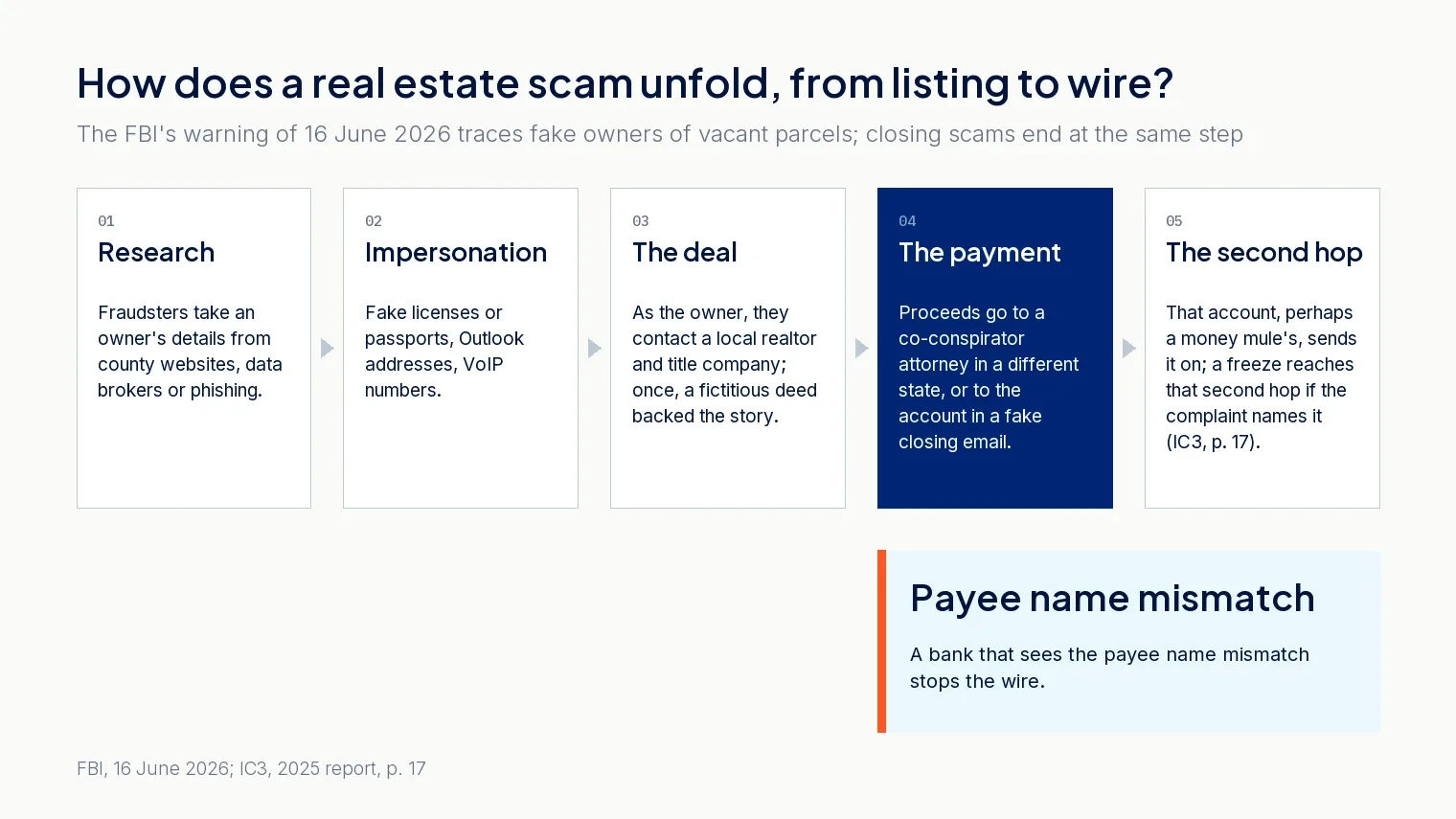
How does a real estate scam unfold, from listing to wire?
The FBI's warning of 16 June 2026 traces fake owners of vacant parcels; closing scams end at the same step:
- Research. Fraudsters take an owner's details from county websites, data brokers or phishing.
- Impersonation. Fake licenses or passports, Outlook addresses, VoIP numbers.
- The deal. As the owner, they contact a local realtor and title company; once, a fictitious deed backed the story.
- The payment. Proceeds go to a co-conspirator attorney in a different state, or to the account in a fake closing email.
- The second hop. That account, perhaps a money mule's, sends it on; a freeze reaches that second hop if the complaint names it (IC3, p. 17).
Picture a buyer due to wire a 60,000 dollar deposit. Two days before closing, an email in the title company's style sends "updated instructions". A bank that sees the payee name mismatch stops the wire; if 45,000 dollars has moved on in a second hop, a freeze holds at most 15,000.
Mr Mills, a landlord living overseas, had joined Property Alert, the free email sent when someone applies to change the register. An alert about a mortgage application over £300,000 on his English property led him to call the registry, which stopped it.
Red flags and warning signs: what gives a property scam away?
According to the FBI, signs two to six mark a fake seller; the FTC gives the first, Riverside the last.
- Suspicious property listings. Rent far below the area's norm, or a real listing copied with new contact details (FTC).
- Email or text only. No meeting in person; the seller pleads illness, travel or an emergency.
- Pressure tactics. A rush to close, sometimes below market value.
- Unusual payment requests. An international wire, or one to an account under a different name or far from the property.
- Inconsistent or missing information. No survey or tax papers, or a story that changes.
- Deeds notarized abroad, or other odd documents.
- Lack of professional representation. The Riverside County DA tells owners to see an independent attorney before signing a property away.
For a payee abroad, the country risk index scores the destination's financial crime risk from 0 to 100.
Real estate fraud vs land fraud vs mortgage fraud: where is the line?
A forged deed moves a vacant lot to a stranger, who sells it: that is land fraud. A borrower who gives false financial details for a home loan commits mortgage fraud. A buyer who wires a deposit on a fake attorney's email suffers closing wire fraud.
Real estate fraud covers all three, plus rental, rescue and investment schemes. They differ in the target: a title, a lender's money or a buyer's funds.
How do AML tools help prevent and combat real estate fraud?
Technology's role in combating real estate fraud starts at the payment, where stolen money has to move. Four checks strengthen detection, and businesses that handle closings can implement them effectively:
- Identify every party. KYC on buyer, seller, payee and the true owner behind a company or trust.
- Verifying the payee. The account name and number checked before a first payout.
- Real-time monitoring. A transaction monitoring system scores high value payments to new payees.
- Prevent the loss with a fast recall. Ask the bank for a recall and file at ic3.gov with full transaction details; in 2025 freeze requests held 58 percent of $1.16 billion (p. 17). In England and Wales, tell HM Land Registry's property fraud team and Report Fraud.
In complead's fraud prevention software, onboarding, screening, monitoring, fraud and investigation run on one engine, so a customer carries one score instead of a separate score in every tool. AI agent output carries the evidence; the fraud team decides to hold, block or release a payment. How fraud detection works covers the methods and solutions for reducing such losses.
Three guidelines for this week:
- Always confirm wiring instructions on a phone number agreed in advance (CFPB).
- Ask the county recorder or clerk for an alert when a document is recorded in your name (FBI), or join Property Alert.
- Treat bank details sent by email as unverified.
Related terms
- Land fraud. Deception over who owns land, often a forged deed.
- Mortgage fraud. A home loan won by lies or by posing as the owner.
- Wire fraud. The US federal crime of a scheme to defraud run over wires.
- Impersonation fraud. Posing as someone the victim trusts.
- Identity fraud. Acting as someone else to borrow, buy or sell.