
The FCA asks mortgage intermediaries: "is declared income believable compared with stated employment?" (FCG 4.2.3). If the answer is no and the lender lends anyway, the file holds a false figure and a lender relying on it.
What is mortgage fraud?
Mortgage fraud is what fraud is in general, aimed at a home loan. The Federal Housing Finance Agency (FHFA) gives the definition on its fraud prevention page, modified 21 May 2026: "Mortgage fraud is characterized by a material misstatement, misrepresentation, or omission in relation to a mortgage loan, which is then relied upon by a lender."
The OCC's Mortgage Fraud page puts it shorter: "deceit or misrepresentation in the origination or funding of a mortgage loan."
Fraud for profit or fraud for housing: what are the two categories?
FHFA says mortgage fraud "takes two primary forms." Fraud for profit "usually involves industry insiders such as appraisers, brokers, and loan originators." Fraud for housing "primarily consists of illegal actions by borrowers" trying "to acquire or maintain ownership of a home." FinCEN's 2006 assessment calls the second group fraud for property.
How does mortgage fraud work, from application to default?
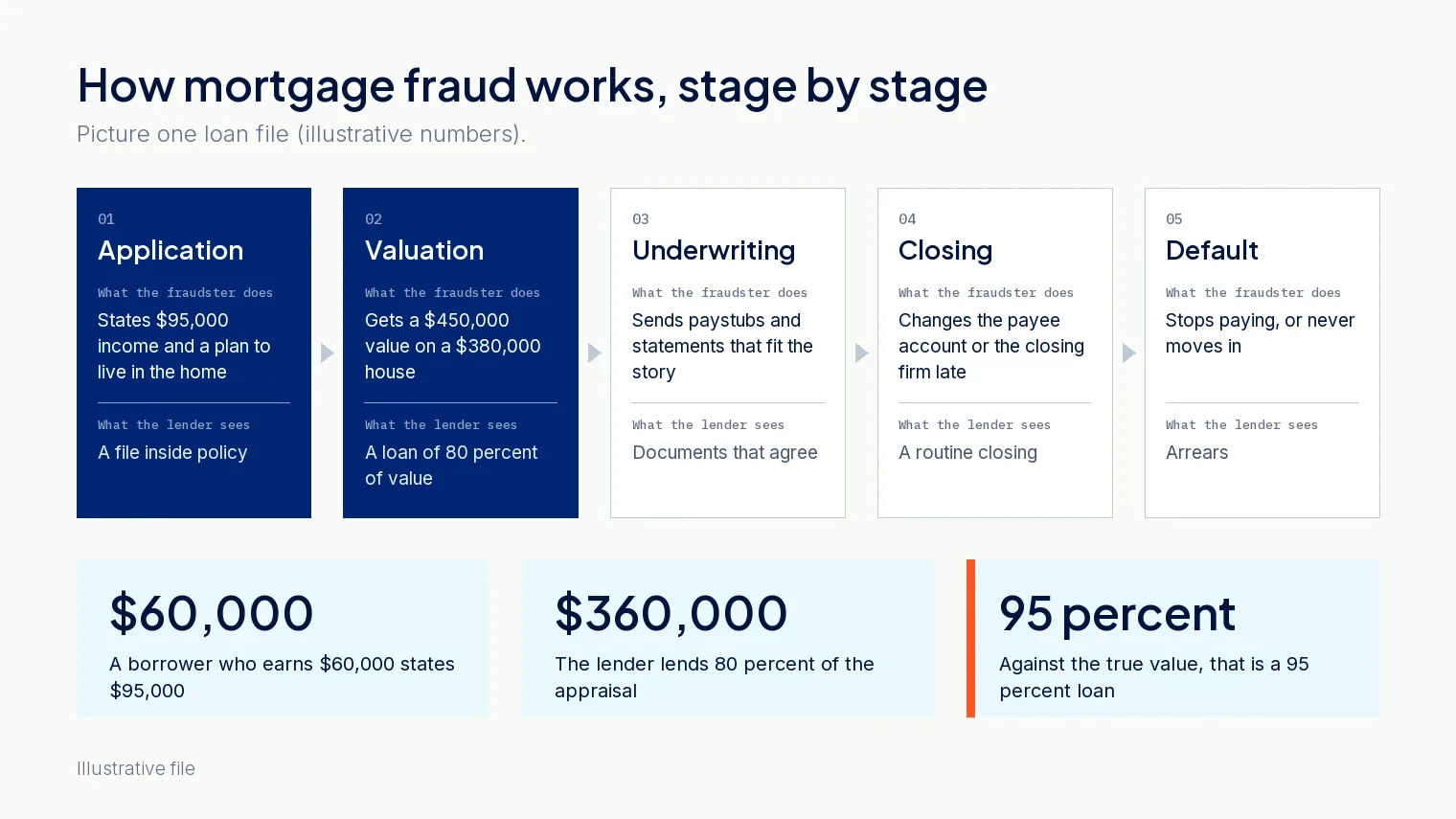
Picture one loan file (illustrative numbers). A borrower who earns $60,000 states $95,000, and an appraiser values a $380,000 house at $450,000. The lender lends 80 percent of the appraisal, $360,000. Against the true value, that is a 95 percent loan.
Table 1. How mortgage fraud works, stage by stage (illustrative file).
| Stage | What the fraudster does | What the lender sees | Who can catch it |
|---|---|---|---|
| Application | States $95,000 income and a plan to live in the home | A file inside policy | The underwriter, testing income against the job |
| Valuation | Gets a $450,000 value on a $380,000 house | A loan of 80 percent of value | A valuation review against nearby sales |
| Underwriting | Sends paystubs and statements that fit the story | Documents that agree | The fraud team, checking employer and bank |
| Closing | Changes the payee account or the closing firm late | A routine closing | The closing team, paying only as instructed |
| Default | Stops paying, or never moves in | Arrears | Collections, then the SAR filer |
"Occupancy is the lie that surfaces after the money is out: in FinCEN's 2006 sample it was 104 of the 129 narratives about a misstated loan purpose or misused proceeds, so check where the statements and tax bills for the 'home' go in the first months, not only at application," says Ufuk Gürdaş, compliance specialist and this entry's reviewer.
Which common techniques do mortgage fraudsters use?
Table 2. Common techniques and types of mortgage fraud (FHFA scheme list).
| Technique | What is misstated | FHFA group | Who is harmed |
|---|---|---|---|
| Income and down payment | Income, assets, or a loan disguised as a gift | Borrower | The lender |
| Employment | The job or the employer | Borrower | The lender |
| Identity and synthetic identity | Who the borrower is | Borrower | The lender; the person whose details are used |
| Occupancy | The plan to live in the home | Investor | The lender |
| Straw buyer | Who the real buyer is | Investor | The lender |
| Flipping | The resale value, after a quick inflated appraisal | Investor | The resale lender |
| Appraisal | The value, above or below market | Industry | Lenders and later buyers |
| Air loan | Borrower and property, both invented | Industry | The lender |
| Shotgunning | Other loans on the same property | Industry | Several lenders |
| Foreclosure rescue | A promise to save the home | Distressed homeowners | The homeowner |
| Title and deed fraud | Who owns the property | Homeowners | The true owner |
The last row is title fraud and deed fraud, where a forged deed moves a home without its owner knowing. These four rows need a closer look: income, employment, occupancy and appraisal.
Income fraud
FHFA describes income fraud as "providing false income information to qualify for a loan," with income and assets "inflated or completely manufactured." In FinCEN's 2006 sample, false statements, from altered bank statements to forged earnings records, appeared in 692 of 1,054 narratives.
Employment fraud
FHFA's entry "Employment Fraud" covers a borrower or straw buyer who misrepresents a job, to look qualified or "to conceal the illegal source of future loan payments."
Occupancy fraud
Occupancy fraud is a false claim to live in the home, made to get better terms than a second or investment home would (FHFA). In FinCEN's sample of SARs filed from 1 April 1996 to 31 March 2006, it appeared in 104 of 129 narratives on a misstated loan purpose or misused proceeds.
Appraisal fraud
Appraisal fraud values a property "either above or below its true market value" (FHFA). FinCEN's section "Appraisal Fraud and Property Flipping" counted 111 of the 1,054 sampled narratives (10.55 percent), with collusion suspected in 48.
What are examples of mortgage fraud?
Kenneth Blair's case, in three dates:
- August 2020 to July 2021. Blair prepares fake paystubs "to show fabricated income from employers" and altered bank statements; lenders fund unqualified borrowers, who pay him.
- 15 May 2024. He pleads guilty to bank fraud.
- 3 September 2026. The US Attorney's sentencing release reports 30 months in prison and a $15,475 forfeiture.
What are the red flags of mortgage fraud?
The FCA's guide and the FSA's 2011 review of mortgage lenders supply four of these checks, and FHFA two.
- Income against the job. The FCG 4.2.3 question; Blair's clients had paystubs made to order.
- Loan size against the location. FCG 4.2.3 also asks whether the mortgage requested fits what the firm knows about where the property is.
- The deposit's source. Verify the deposit is "from a legitimate source" (FCTR 11.3.2); FHFA lists down payment loans dressed up as gifts.
- A conveyancer changed mid application. Contact the old and the new firm to confirm the change has a legitimate reason (FCTR 11.3.4).
- Applications probing limits. Brokers "gaming" a lender send files built to find its lending thresholds, or many similar files just inside policy (FCTR 11.3.4).
- Two loans on one property. In shotgunning, each lender funds without knowing about the others (FHFA).
For homeowners, the OCC flags offers to modify a mortgage for an upfront fee and points victims to IC3 ("a division of the FBI"), the FTC and their lender.
How is mortgage fraud detected?
FCG 4.2.2's good practice puts detection at three points. Underwriting flags higher risk applications, the existing mortgage book gets reviewed, and before release someone checks that funds are "being dispersed in line with instructions". Rules and models can run the first pass automatically, comparing income with the job and each application with earlier ones. An underwriter or analyst decides. For the systems behind that first pass, see how fraud detection works.
What are the penalties for mortgage fraud in the US and UK?
Table 3. Mortgage fraud law in the US and the UK (texts read 19 October 2026).
| Jurisdiction | Rule | Covers | Maximum or duty | Who enforces |
|---|---|---|---|---|
| US | 18 U.S.C. 1014 | Knowingly false statements, or willful overvaluation, made to influence a listed lender, including a mortgage lending business (s27) | A fine up to $1,000,000, up to 30 years, or both | Federal prosecutors |
| US | 18 U.S.C. 1344 | Bank fraud: a scheme to defraud a financial institution or take its property by false pretenses | A fine up to $1,000,000, up to 30 years, or both | Federal prosecutors |
| US | 18 U.S.C. 1343 | Wire fraud | Up to 20 years, a fine, or both; where it affects a financial institution, up to 30 years, a $1,000,000 fine, or both | Federal prosecutors |
| US | FIRREA, 12 U.S.C. 1833a | Civil penalty for 1014, 1344, and 1343 affecting a federally insured institution | $1,000,000; for a continuing violation, $1,000,000 a day or $5,000,000, whichever is less; or up to the gain or loss | The Attorney General, within 10 years |
| US | 31 CFR 1029.320 | Loan or finance companies, such as non bank residential mortgage lenders and originators | SAR at $5,000 or more, within 30 calendar days of detection | FinCEN |
| US | 12 CFR 1233.3 | Fannie Mae, Freddie Mac, Federal Home Loan Banks | Report to FHFA a fraudulent loan bought or sold, or a suspected fraud | FHFA |
| UK | Fraud Act 2006, s1, s2, s3 | False representation; failing to disclose | On indictment, up to 10 years or a fine, or both | Prosecutors in England, Wales and Northern Ireland (s15) |
| UK | FCG 4.2; Information from Lenders | Lender and broker controls; reporting to the FCA | Guidance; voluntary scheme | The FCA, as supervisor |
One false income figure can fall under several rows, and FHFA notes state penalties as well as federal ones. The Fraud Act 2006 offenses extend to England, Wales and Northern Ireland only (section 15), so Scotland sits outside them.
Where does mortgage fraud sit in a fraud and AML program?
The fraud team owns the application: income, job, occupancy and value. The anti money laundering (AML) team owns the money: the deposit's source, customer due diligence (CDD) and the suspicious activity report. FHFA notes that a transaction involving the proceeds of any fraud "can be a predicate offense for money laundering." The SAR rule in Table 3 sits under the Bank Secrecy Act (BSA).
At the payout, the bank transaction fraud monitoring of complead, formerly Sanction Scanner, scores a transfer before it executes and checks the payer, the payee and any bank in between. The fraud team then holds, blocks or releases it. For the life of the loan, the lending and leasing setup keeps the borrower's record under review up to the last payment.
Mortgage fraud vs loan fraud vs real estate fraud: what is the difference?
Michael Saracco, a former attorney who owned a title company, took private loans on properties and left those mortgages unrecorded. Then he sold the properties to buyers whose lenders knew nothing of them. He pleaded guilty to three counts of wire fraud, a release of 14 September 2026 says, and sentencing is set for 2 December 2026. The buyers' lenders relied on papers that hid the old mortgages, which is mortgage fraud, and the method ran through a title company's records, which is real estate fraud.
Table 4. Mortgage fraud, loan fraud and real estate fraud compared.
| Term | Scope | Example |
|---|---|---|
| Mortgage fraud | A material lie a lender relies on for a home loan | Blair's fake paystubs |
| Loan fraud | The wider family: lies on any credit application | The same paystubs on a car loan (illustrative) |
| Real estate fraud | Property schemes beyond the loan: title, closing, rental | Saracco's unrecorded mortgages |
That leaves a lender one decision about timing: check occupancy and the route of the funds before closing, while money can still be held, or meet the lie after default.
Related terms
- Loan fraud. Lies on any credit application, home loans included.
- Real estate fraud. Property schemes beyond the loan, such as title fraud.
- Fraud vs money laundering. Fraud produces the money; laundering disguises where it came from.
- Wire fraud. Fraud through interstate wire communications, the charge in Saracco's plea.