The Office for National Statistics estimated 4.5 million fraud incidents in England and Wales in the year ending March 2026 (ONS, 23 July 2026). Each one that took money left criminal property behind, and moving that property is a second crime with its own statute.
What is the difference between fraud and money laundering?
Table 1. Fraud vs money laundering.
| Fraud | Money laundering | |
|---|---|---|
| Legal core | Deception to make a gain or cause a loss | Concealing, converting or moving criminal property |
| The question it asks | Is the money really there? | Where did the money come from? |
| Victim | A person or firm that was deceived | Often no single victim; the financial system |
| Timing | First: it creates the proceeds | Afterwards: it handles the proceeds |
| UK offense | Fraud Act 2006, section 1 | Proceeds of Crime Act 2002, section 327 |
| US offense | Wire fraud (18 U.S.C. 1343) and other listed frauds | 18 U.S.C. 1956 and 1957 |
| UK maximum | 10 years | 14 years |
| US maximum | 20 years for wire fraud, 30 if it affects a financial institution | 20 years (1956) |
| What the firm does | Blocks the payment and contacts the customer | Reports the suspicion and says nothing to the customer |
Fraud is about how the money was obtained; laundering is about what is done with it afterwards. Section 327 of the Proceeds of Crime Act 2002 makes it an offense to conceal, disguise, convert, transfer or remove criminal property. In the US, 18 U.S.C. 1956 punishes a transaction designed "to conceal or disguise the nature, the location, the source, the ownership, or the control" of the proceeds.
Embezzlement shows the order. An employee who diverts company funds commits the fraud, and hiding those funds afterwards is the laundering.
Is money laundering a type of fraud?
No. Money laundering is a separate offense, and fraud is one of the crimes that feed it, a predicate offense. Fraud is one branch of financial crime; laundering is another.
Table 2. Fraud as a predicate offense, by jurisdiction.
| Jurisdiction | Which crimes can be laundered | Is fraud covered? | Self laundering | Maximum for laundering |
|---|---|---|---|---|
| United Kingdom | All crimes: conduct that "constitutes an offence in any part of the United Kingdom" (POCA s340(2)) | Yes, like every offense | Covered: it is "immaterial" who carried out the crime (s340(4)) | 14 years (s334) |
| United States | Listed crimes, "specified unlawful activity" (18 U.S.C. 1956(c)(7)) | Mail, wire and bank fraud are listed (18 U.S.C. 1961(1)) | Not excluded: section 1956 applies to "whoever" conducts the transaction | 20 years, or a fine up to $500,000 or twice the value |
| European Union | Offenses punishable by over one year, plus a list (Directive (EU) 2018/1673, Article 2(1)) | Yes, Article 2(1)(i) | Member States must criminalize it (Article 3(5)) | At least four years (Article 5(2)) |
The UK rule is the widest: any crime can produce criminal property, so every fraud does. The US lists its predicates, and the main fraud statutes are on the list. EU law adds that a laundering conviction needs no prior conviction for the fraud (Article 3(3)(a)).
Self laundering puts both crimes on one person. Picture a seller who takes 30,000 dollars for goods that never ship, then moves the money through three accounts. In the UK and the EU, that seller can be convicted of the fraud and of laundering its proceeds.
What is the relationship between fraud and money laundering?
The two crimes share one money trail. The UK's national risk assessment of 2025 names the usual routes: retail bank accounts and money mules, people who move proceeds for someone else.
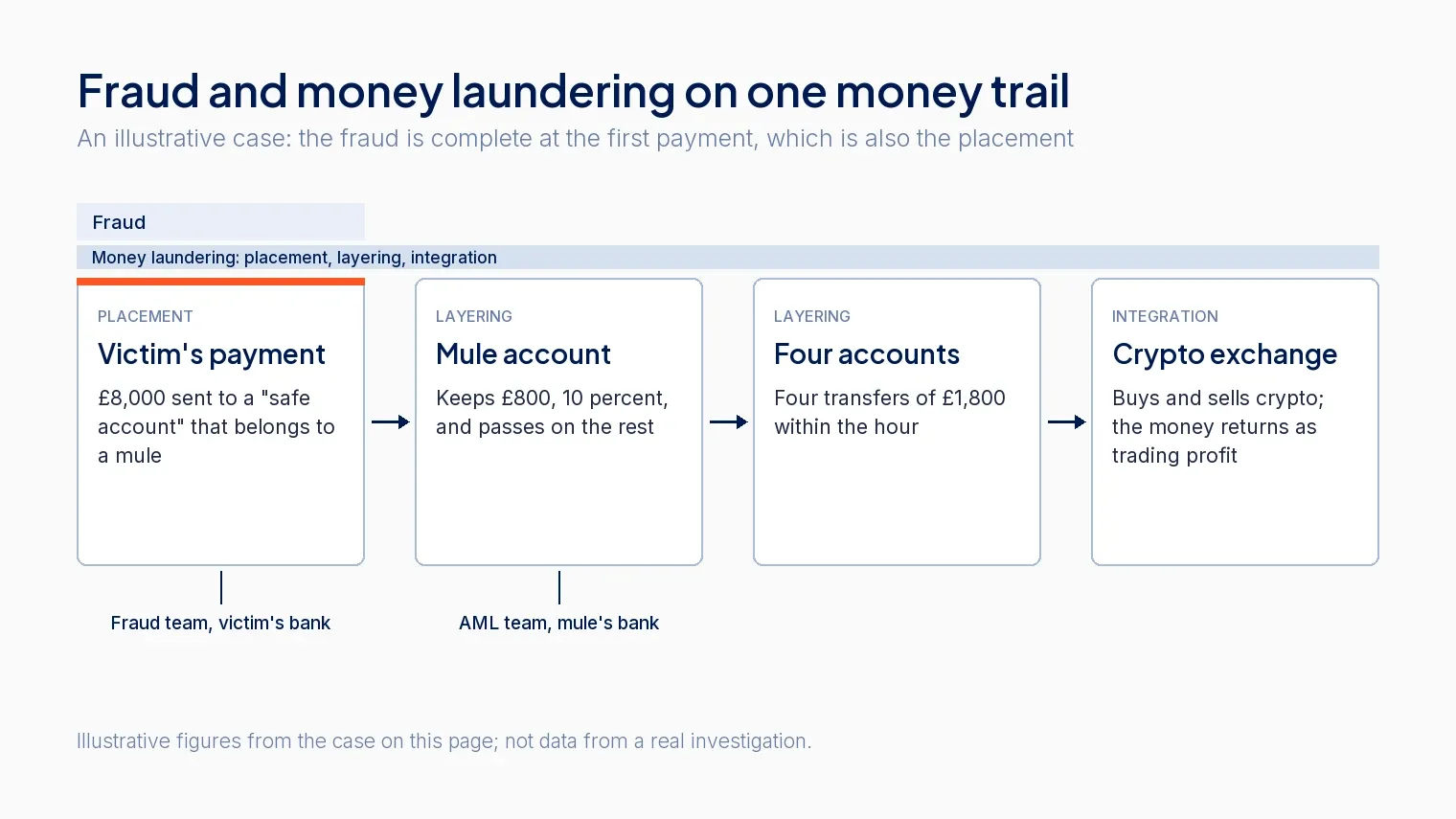
Follow one illustrative case:
- Placement. A caller posing as the bank tells a victim her account is compromised. She sends 8,000 pounds to a "safe account" that belongs to a mule.
- Layering. The mule keeps 800 pounds, 10 percent, and sends four transfers of 1,800 pounds to four other accounts within the hour.
- Integration. Those accounts buy crypto, sell it on an exchange and bring the money back as trading profit.
The fraud is complete at step 1, and the same payment is the placement. Layering and integration follow, the last two of the three stages of money laundering.
When does fraud become money laundering?
In the UK, almost at once. The national risk assessment says: "The proceeds from fraud are criminal funds as soon as the victim has been deceived into sending funds. This means that when using those criminal funds, the offender is then laundering them" (HM Treasury and Home Office, 17 July 2025, paragraph 3.9).
US law asks for a further act: a financial transaction that promotes the crime or is designed to conceal the proceeds (section 1956), or a transaction over $10,000 in criminally derived property (18 U.S.C. 1957). Before taking on a customer, you can check a name for fraud and money laundering allegations in the news.
What is the difference between anti fraud and AML departments?
Take the 8,000 pound payment above. At the victim's bank, the fraud team wants to stop it and call her. At the mule's bank, the AML team sees money arrive and leave within the hour and must decide whether to report it.
The motives differ. Fraud teams protect the firm from loss and can count their value in money saved. AML teams meet a legal duty and are often seen as a cost center.
The law treats them differently as well. A US bank files a suspicious activity report on a transaction of at least $5,000 when it "knows, suspects, or has reason to suspect" illegal funds (31 CFR 1020.320), and may not tell "any person involved in the transaction that the transaction has been reported" (31 U.S.C. 5318(g)(2)). UK tipping off carries up to two years (POCA s333A).
"A fraud analyst's first move is to call the customer; once a suspicious activity report is filed, the same call can be tipping off, so in a shared case the AML side clears any customer contact first," says Burçak Aydın, who has worked in AML/CFT compliance at a bank and a payment institution.
Should fraud and AML teams work together?
Yes on data, no on decisions. Both use transaction monitoring, customer and account information, peer group definitions and watchlists, so a shared customer record saves two investigations of one person. Each team still makes its own call, the fraud team on the loss and the AML team on the report. Running fraud and AML on one customer record is called FRAML, and the guide to how fraud detection differs from AML monitoring covers the systems.
Where do fraud and money laundering sit in an AML program?
Preventing money laundering and fraud starts at onboarding, where both crimes meet the same two obligations. Know your customer (KYC) checks, identity verification among them, confirm who the customer is and record the expected activity.
Customer due diligence (CDD) sets how deep the checks go on a risk based scale: simplified due diligence (SDD) for low risk customers, standard CDD, and enhanced due diligence (EDD) for high risk ones such as politically exposed persons (PEPs), where money laundering and terrorist financing (ML/TF) risk sits. The same checks stop a fraudster opening an account and a mule account from receiving stolen money.
Once the account is open, transaction monitoring software flags payments that break the customer's recorded pattern, such as the mule's four onward transfers, and screening against sanctions and PEP watchlists catches known risks. Both are AML program controls, and an alert from either can end in a suspicious activity report. The fraud team reads the same alerts for the loss.
Trace any one of the 4.5 million incidents that took money and the split repeats: the victim's bank sees a fraud, the mule's bank sees laundering, and each answers to its own duty for the same payment.
Related terms
- Predicate offense. The crime that produced the proceeds being laundered.
- Money mule. A person who moves criminal proceeds through their own account.
- FRAML. Fraud and AML work run on one customer record.
- Suspicious activity report. The report a firm files when it suspects laundering.
- Transaction laundering. Illegal sales processed through an approved merchant account.
- Serious Fraud Office (SFO). The UK prosecutor of serious or complex fraud, bribery and corruption.