
The FBI's Internet Crime Complaint Center (IC3) logged 24,768 business email compromise (BEC) complaints in 2025, with $3,046,598,558 in reported losses, second only to investment fraud (2025 Internet Crime Report, April 2026, pp. 7 and 8).
What is wire fraud?
18 U.S.C. 1343, added on 16 July 1952 and amended since, makes fraud a federal crime when it runs by wire. It reaches anyone with "any scheme or artifice to defraud" who "transmits or causes to be transmitted by means of wire, radio, or television communication in interstate or foreign commerce" a message to carry it out.
The wire, in its legal meaning, is the message. The archived DOJ Criminal Resource Manual 941 requires "an interstate telephone call or electronic communication made in furtherance of the scheme", so one email across state lines can be enough.
What must prosecutors prove?
CRM 941 collects how courts define the elements. The short test has two: a scheme to defraud, and an interstate wire used to further it (United States v. Maxwell, D.C. Cir. 1990). An Eighth Circuit case lists four, adding intent and foreseeable use of the wires. No loss is needed: courts quoted in CRM 943 hold that success and loss "are not essential elements of the crime".
How does wire fraud work? One FinCEN scenario, stage by stage
In FinCEN's advisory of 6 September 2016, a criminal poses as one of Company C's suppliers and emails that future invoices go to a new account. Company C updates the record and pays the criminal (Scenario 3).
Table 1. FinCEN's Scenario 3, stage by stage (the 2016 advisory; the cash out row adds the 2019 advisory).
| Stage | What the criminal does | What the payer sees | Who can stop it |
|---|---|---|---|
| 1. Compromise | Takes over or imitates an email account | Nothing | Email security at both firms |
| 2. Instruction | Emails new bank details as the supplier | A routine change of account notice | The payer, calling a known number |
| 3. Execution | Waits for the next invoice payment | A normal outgoing wire | The sending bank, before release |
| 4. Cash out | Moves the money on | Nothing, until the supplier chases payment | The receiving bank: name and account differ |
Each interstate email in stages 1 and 2 is a wire, so this is wire fraud although the payer authorized the transfer. FinCEN warns such transfers "are often irrevocable". Its advisory of 16 July 2019 sees the proceeds increasingly land first in US accounts, likely through money mule networks.
What are some examples of wire fraud?
One example of wire fraud needs no supplier: a criminal uses a Company B executive's email to order a wire from the employee who issues payments (2016, Scenario 2). The 2019 advisory calls this CEO fraud, behind about half of BEC aimed at financial institutions. Operation WireWire, announced in June 2018, brought 74 arrests and charged 15 alleged money mules (2019).
What types of wire fraud schemes are there, and what stops them?
Table 2. Six wire fraud schemes compared.
| Scheme | How the wire is used | Who it hits, per the source | Control |
|---|---|---|---|
| Business Email Compromise (BEC) | A hijacked or lookalike account orders a wire | Firms that pay suppliers by wire (IC3) | Dual authorization and a call back |
| Vendor Impersonation | A "supplier" emails new bank details | The supplier's customers (FinCEN) | Verify bank details by phone |
| Fake Invoice or Billing Scams | A false invoice names the criminal's account | Firms paying vendors; larger sums than CEO fraud (FinCEN) | Match invoices to known orders |
| Real Estate Transaction Fraud | Changed closing instructions from a hijacked email | Buyers, sellers, realtors, escrow firms (FinCEN) | Confirm by phone with escrow |
| Romance Scams | The victim wires money to a trusted online contact | 23,159 complaints, $929,287,469 lost in 2025 (IC3 Confidence/Romance) | A second person checks the wire |
| Phishing enabled bank fraud | Stolen logins send the wire from the victim's account | Bank customers whose stolen details feed account takeovers (FinCEN) | Anti phishing filters and stronger logins |
These rows overlap: four are impersonation fraud, where someone poses as a customer, executive, supplier or realtor; the last is closer to account takeover.
Who is most at risk of wire fraud?
- Small and Medium Sized Enterprises. Fraudsters weigh company size, FinCEN says, but it names no size band (2019).
- Real Estate Agencies and Law Firms. Their clients are among the likeliest targets of email account compromise (2016).
- High Net Worth Individuals. They are BEC targets "particularly and increasingly" (2019).
- Elderly People. 642 of IC3's 3,900 kill chain incidents in 2025 involved victims 60 or over (p. 18).
- International Trade Companies. In international wire fraud, vendor impersonation often sends the first payment to a foreign intermediary (2019).
What are wire fraud red flags?
The 2016 advisory lists eleven red flags and says no single one "necessarily indicates suspicious activity"; the 2019 advisory says they "remain relevant".
What should a payer watch for?
- Changed beneficiary details. A known payee with a new account number.
- A lookalike address. One character added, changed or deleted.
- Pressure words. Requests marked "Urgent", "Secret" or "Confidential".
- A first time sender. A newly authorized employee sends wire instructions.
What does the receiving bank see?
FinCEN's last red flag belongs to the receiving bank: a wire that "names a beneficiary that is not the account holder of record". Before acting on new wire instructions, check a beneficiary bank's SWIFT code.
In a bank's AML program, a reportable case means a suspicious activity report within 30 calendar days, even when the scheme failed, with "BEC FRAUD" in the narrative and field 42, Cyber event (2019).
Which laws cover wire fraud, and what are the penalties?
Table 3. Laws that cover wire fraud, by jurisdiction.
| Jurisdiction | Rule | Covers | Maximum | Time to charge | Who checks |
|---|---|---|---|---|---|
| US | 18 U.S.C. 1343 | Wire fraud | A fine, 20 years, or both; if it involves a declared major disaster or emergency benefit or affects a financial institution, $1,000,000, 30 years, or both | 5 years; 10 if it affects a financial institution | Federal prosecutors; IC3 takes complaints |
| US | 18 U.S.C. 1349 | Attempt or conspiracy | "the same penalties" as the offense | 5 years; 10 for a conspiracy that 3293 covers | Federal prosecutors |
| US | 18 U.S.C. 1341 | Mail fraud, by the Postal Service or an interstate carrier | As 1343 | As 1343 | Federal prosecutors; USPIS takes reports |
| US | 18 U.S.C. 1344 | Bank fraud | $1,000,000, 30 years, or both | 10 years | Federal prosecutors |
| US | 18 U.S.C. 1956(c)(7)(A) and 1961(1) | Laundering the proceeds; 1961(1) lists "section 1343 (relating to wire fraud)" | The greater of $500,000 or twice the value involved, 20 years, or both | None in the section | Federal prosecutors |
| US | 31 CFR 1020.320 | Bank SARs on suspicious transactions of $5,000 or more | A filing duty | File in 30 calendar days; keep five years | FinCEN and the bank's federal examiner |
| England, Wales and Northern Ireland | Fraud Act 2006, s1 and s2 | Fraud by false representation, including to "any system or device" | 10 years, a fine, or both, on indictment | None set in the Act | Police and prosecutors |
Time to charge comes from 18 U.S.C. 3282, five years for offenses not capital, and 18 U.S.C. 3293, ten where wire or mail fraud affects a financial institution.
In England, Wales and Northern Ireland, a dishonest false representation made to gain money is fraud under Fraud Act section 2, and sections 1 to 9 extend there only (s15(2)). For UK bank transfer scams, see APP fraud.
What are the penalties for wire fraud?
Section 1343 reads "shall be fined under this title or imprisoned not more than 20 years, or both", rising to "fined not more than $1,000,000 or imprisoned not more than 30 years, or both" when the violation "affects a financial institution" or involves a declared major disaster or emergency benefit.
From Ufuk Gürdaş, reviewer of this entry: "A wire fraud that affects a financial institution can be charged for ten years (18 U.S.C. 3293) instead of five, but a bank must keep the suspicious activity report and its supporting documents for only five years from filing (31 CFR 1020.320), so the retention clock can run out first."
Wire fraud, mail fraud or bank fraud: which statute applies?
Wire fraud needs an interstate or foreign wire, radio or TV communication; mail fraud, the Postal Service or an interstate carrier; bank fraud, a scheme against a financial institution or the money it holds. Laundering the proceeds is a separate crime, set out in fraud and money laundering.
What is mail fraud?
Mail fraud is the same scheme run through "any post office or authorized depository for mail matter" or "any private or commercial interstate carrier" (section 1341). The DOJ's Elements of Mail Fraud entry, Criminal Resource Manual 940, gives its legal definition two elements: the scheme, and a mailing to execute it. The US Postal Inspection Service (USPIS) takes reports of suspected scams "related to the U.S. Mail", from sweepstakes to romance; IC3 files Ponzi schemes under investment fraud. Recognizing the signs of fraudulent mail starts at the mailbox, with a prize you never entered. Scammers who switch to email fall under the wire statute.
How can you protect your business from wire fraud?
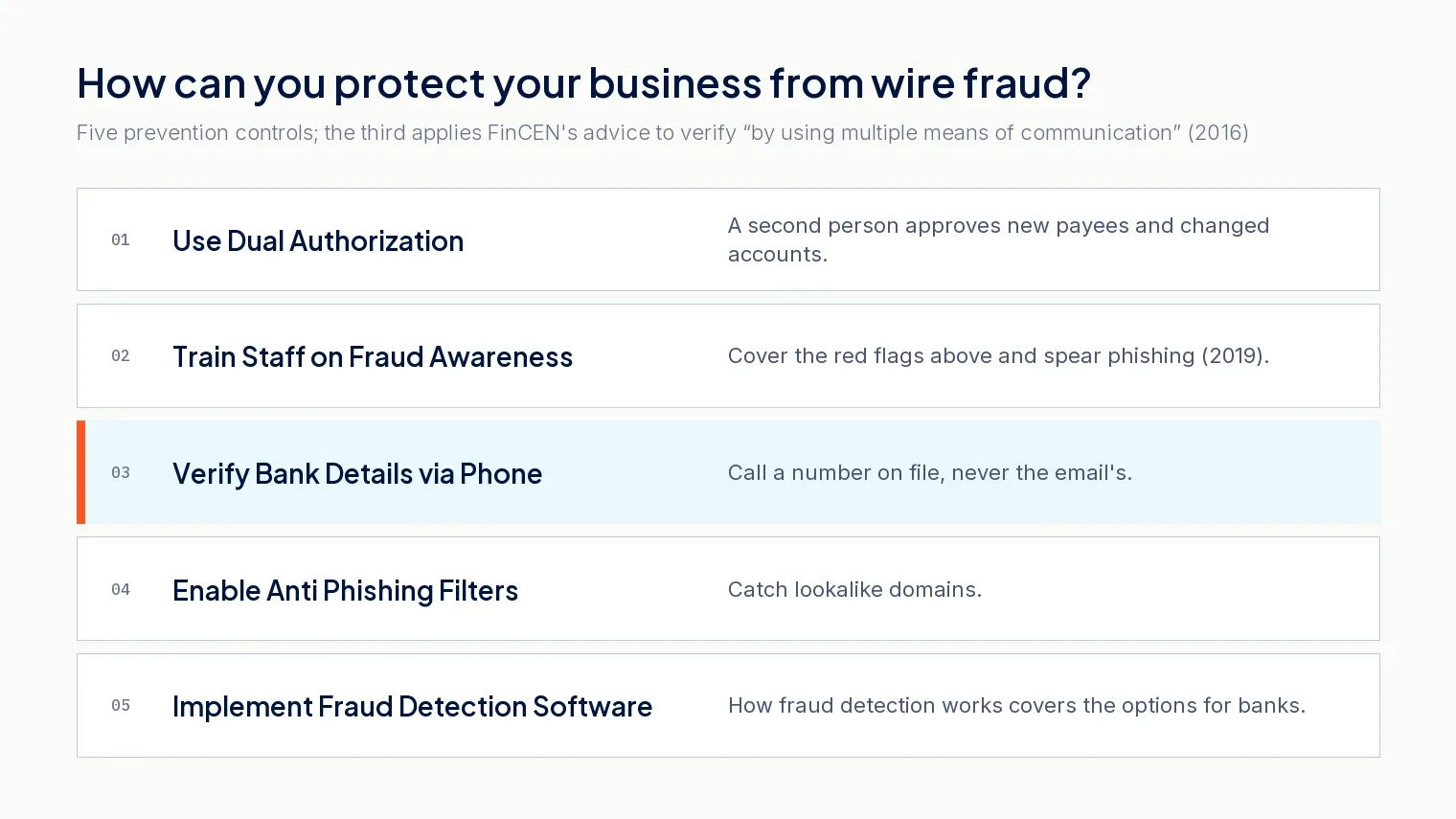
Five prevention controls; the third applies FinCEN's advice to verify "by using multiple means of communication" (2016):
- Use Dual Authorization. A second person approves new payees and changed accounts.
- Train Staff on Fraud Awareness. Cover the red flags above and spear phishing (2019).
- Verify Bank Details via Phone. Call a number on file, never the email's.
- Enable Anti Phishing Filters. Catch lookalike domains.
- Implement Fraud Detection Software. How fraud detection works covers the options for banks.
complead, formerly Sanction Scanner, offers bank transaction fraud monitoring that scores each transfer and its payee before it is executed; the fraud team decides whether to hold, block or release it.
What should you do if you fall victim to wire fraud?
After a fraudulent wire, IC3 says time is of the essence: contact your bank and "request a recall of the funds", then file a complaint at ic3.gov whatever the amount. Its Recovery Asset Team froze $679,013,183 of the $1,163,919,846 attempted in 2025, 58 percent (p. 17). FinCEN has recovered more when wires were reported within 24 hours (2019). Keep the emails. You will need them for the investigation.
CEO fraud, Scenario 2's scheme, needs one employee who moves money on an executive's email.
Related terms
- CEO fraud. A fake executive orders a payment.
- APP fraud. The victim is tricked into paying.
- ACH fraud. Fraud on automated clearing house payments.
- Check fraud. Fraud with paper checks or check images.
- Account takeover fraud. Payments from a hijacked account.
- Money mule. Someone whose account moves criminal money.