
Losses in that category reached $275.1 million in 2025, up from $173.6 million in 2024 (IC3 2025 Internet Crime Report, pages 25 and 26). In June 2026, the FBI issued a separate warning about criminals who pose as the owners of vacant land and sell it.
What is land fraud?
Land fraud is fraud in which the asset is land or its title. Typically, it entails a false statement about the land or its owner, or a forged deed that moves the title. It thrives where land registers are thin and buyers or sellers are desperate.
Section 2 of the Fraud Act 2006 covers anyone who "dishonestly makes a false representation" for gain. India's Bharatiya Nyaya Sanhita calls a false document made "to support any claim or title" forgery (section 336). Title fraud and deed fraud are names for the forged paper route; real estate fraud is the wider family.
What is a land swindler?
A land swindler, in the everyday meaning, is a dishonest dealer who takes money for land by deceiving its buyer or owner. The Cambridge Dictionary defines a swindler as "someone who gets money dishonestly by deceiving or cheating people". The fake owner in the FBI's warning is a current example.
How does land fraud work?
Picture an Ohio owner with 10 acres of vacant Texas land she has not seen in years. Without her knowledge, the plot is listed below market value and a buyer's money heads to a stranger. The FBI's warning of 16 June 2026 describes three phases:
- Impersonation. Criminals create fake driver's licenses or passports, Outlook email addresses and VoIP numbers in the owner's name. The details come from public records, data brokers, stolen accounts or phishing.
- Contact. They approach a local realtor and a title company to market the parcel. In one case, a fake deed backed the story.
- Payment. The money goes to an accomplice attorney in another state.
Fraudsters frequently pick vacant, unmortgaged parcels, and GOV.UK lists both as risk factors: no resident or lender is watching. The US Postal Inspection Service also describes scammers who sell property they do not own with forged deeds and fake notary stamps.
What are the types of land fraud?
Table 1. Types of land fraud.
| Type | How it works | Who loses | Document faked |
|---|---|---|---|
| False ownership claim | Con artists claim land they do not own, with fabricated papers | Buyer | Title or sale deed |
| Owner impersonation | A fraudster poses as the owner of a vacant parcel | Owner, buyer | ID, deed, email |
| Forged deed | A forged transfer puts the title in the fraudster's name | Owner, lender | Deed, notary stamp |
| Double selling | One plot is sold to two or more buyers | Later buyers | Sale agreement |
| Encumbrance fraud | The seller hides a mortgage, lien or dispute | Buyer | Encumbrance record |
| Non existent land | The plot does not exist or lies elsewhere | Buyer | Maps, survey |
| Overpricing | Remote or unusable land sold at inflated prices, often unseen | Buyer | Brochures, valuations |
| Land banking | Small plots sold on a promise of planning permission | Investors | Planning claims |
Indian law uses double selling as its own example of cheating (section 318, illustration (i)). A seller who has already sold an estate to B sells or mortgages it to Z without saying so, and takes Z's money. Land bought unseen from a brochure is the overpricing row, which USPIS describes. A bogus land deal can combine two rows, such as a forged deed and a hidden debt.
On land banking, the UK's Financial Conduct Authority says planning permission is often not granted or even applied for. Land investments are not regulated by the FCA, so buyers have no access to the Financial Ombudsman Service or the Financial Services Compensation Scheme.
What is land forgery?
Land forgery is making or using a false deed, power of attorney or notary stamp to claim or transfer land. In India, forgery for cheating carries up to seven years (section 336(3)), and using the forged deed as genuine is punished the same way (section 340).
How do you identify land fraud?
The FBI's warning lists five red flags in a land sale:
- Contact only by email, text or a VoIP number, with illness or travel as the reason not to meet.
- A rush to close, helped along by a price below market value.
- Thin knowledge of the parcel, with the survey or tax papers missing and the details inconsistent.
- A request to wire the money abroad, to an account in another name or to a place unrelated to the land.
- A deed notarized in a foreign country, or other paperwork that is odd for a local sale.
Money that has moved on is hard to recover. A buyer who spots these flags after paying should call the bank at once, then report the receiving account to IC3 in the US, as the FBI asks, or to Report Fraud in the UK, as GOV.UK advises.
Check the counterparty's history too, above all for a developer or repeat seller.
How do you prevent land fraud?
For one parcel, prevention means checking the land, the seller and the payment before money moves. Bank level programs are in the fraud detection and prevention guide.
Checklist for purchasing land
Table 2. Checks before a land purchase.
| Check | What it catches | Where |
|---|---|---|
| Title search over 20 to 30 years | False ownership, double selling | Land register or sub registrar |
| Encumbrance certificate or lien search | Hidden mortgages, liens, disputes | Sub registrar (India), county recorder (US) |
| Seller's ID against the register, in person | Owner impersonation | Lawyer or notary |
| Certified letter to the address on the tax record | A fake seller | County tax record (FBI advice) |
| Site visit and survey | Non existent land, wrong boundaries, encroachment | Certified surveyor |
| Zoning certificate | Land that cannot be used as planned | Local planning office |
| Payment into escrow or the titled owner's account | Diverted sale money | Bank, title company, lawyer |
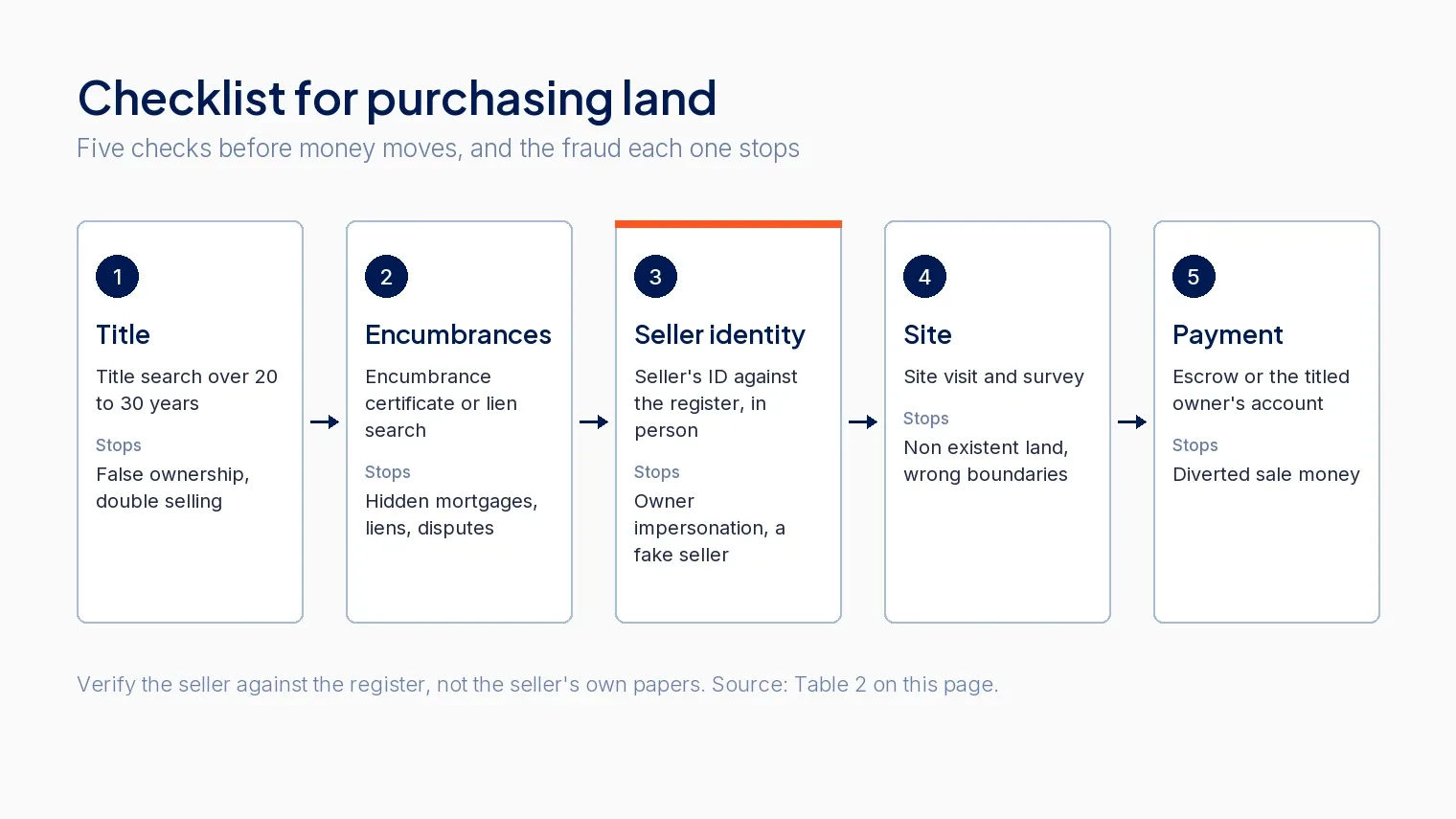
Verify the seller against the register, not the seller's own papers. Steer clear of cash; make every payment traceable.
What does land due diligence cover?
Land due diligence covers four areas: legal (title, deeds, any power of attorney), financial (taxes, liens), physical (boundaries, access, water) and regulatory (zoning, environmental clearance, the developer's record). Obtain each record from the office that keeps it.
What law covers land fraud?
Table 3. Land fraud offenses by jurisdiction.
| Jurisdiction | Offense | Section | Maximum prison term |
|---|---|---|---|
| England, Wales, Northern Ireland | Fraud by false representation | Fraud Act 2006, s2 (penalty s1) | 10 years |
| India | Cheating that induces delivery of property (was IPC 420) | BNS 2023, s318(4) | 7 years |
| India | Cheating by personation | BNS 2023, s319(2) | 5 years |
| India | Forgery for cheating (was IPC 468); using a forged document (was IPC 471) | BNS 2023, s336(3) and s340(2) | 7 years |
| India | Forging a valuable security or a will, or a document that authorizes transferring a valuable security (was IPC 467) | BNS 2023, s338 | Life, or up to 10 years |
| United States (federal) | Wire fraud | 18 U.S.C. 1343 | 20 years, 30 if a financial institution is affected |
The Bharatiya Nyaya Sanhita took effect on 1 July 2024 and repealed the Indian Penal Code (section 358). Older judgments, and cases about earlier acts, still cite IPC 420 and 468. A US land sale arranged by email and paid by wire can be charged as wire fraud. Two of these jurisdictions have a complead whitepaper on their wider anti money laundering regime: anti money laundering in the United Kingdom and the US anti money laundering framework.
Where does land fraud sit in an AML program?
Land fraud reaches a bank at the payout: the buyer's money lands in an account and soon leaves for a name not on the title. Three duties meet there: know your customer checks on seller and payee, monitoring of the proceeds, and a suspicious activity report when the story fails. In the US, FinCEN's Residential Real Estate Rule was vacated by a federal court on 19 March 2026 and is under appeal (FinCEN).
"On the payments side, land fraud usually shows up as a large sale payment that leaves within a day for an account whose holder is not the owner on the title. That name mismatch is the check that catches it," says Burçak Aydın, who worked in AML compliance at a bank and a payment institution.
A bank monitoring bank transfers before the money moves can hold that payout while an analyst checks the payee against the title, then release it, block it or report it.
What are known land fraud cases?
The best known case, the Yazoo land fraud, reached the US Supreme Court. In 1795, Georgia legislators, most of them bribed or holding stakes in the buyers, sold 35 million acres in what is now Alabama and Mississippi to speculators. The next legislature voided the grants. In Fletcher v. Peck (1810), the Court struck down that repeal to protect innocent buyers, and Congress paid compensation in 1814 (Federal Judicial Center).
From 2022 to 2023, a group posed as owners to sell vacant lots in Palm Beach County, Florida, with fake driver licenses and notary credentials; buyers wired the money to its accounts. One member got six years in April 2025 (US Attorney's Office, Southern District of Florida).
An owner of rarely visited land can act this week:
- Set an alert. HM Land Registry's Property Alert covers up to 10 properties free (GOV.UK); in the US, ask whether your county recorder sends filing notifications.
- Check the register. It should show your name and a current address. A restriction is free for companies and for owners who live elsewhere, £40 if you live there. Examine your mail as well; in the US, a tax appraisal notice that never arrives can mean the land has new owners (USPIS).
- Find your title policy. A standard owner's policy may cover forgery (FBI).
Related terms
Real estate fraud. The wider family; the FBI's real estate category also counts investment, rental and timeshare fraud.
Mortgage fraud. Lies on a loan application, or a loan taken out on a stolen title.
Identity fraud. Using someone else's identity to borrow, buy or sell.
Money laundering through real estate. Hiding criminal money in property deals (money laundering methods and typologies).