Credit Suisse Services AG pleaded guilty to conspiring to help US taxpayers hide more than $4 billion in at least 475 offshore accounts, and agreed to pay about $510.6 million (IRS Criminal Investigation, Annual Report 2025). Its bankers falsified records. Tax fraud is the branch of fraud aimed at the state's revenue.
What counts as tax fraud?
Two elements define tax fraud, in the IRS manual's words: "a tax due and owing; and fraudulent intent" (IRM 25.1.1.3). Intent here means willfulness, and "a good faith misunderstanding of the law" negates it (IRM 25.1.1.5).
GAO estimates the federal loss to tax fraud at $116 billion to $304 billion a year (2018 to 2024 data; GAO, 25 September 2026). HMRC puts the UK tax gap at £59.2 billion for 2024 to 2025, 12 percent of it evasion, and counts honest error and carelessness separately (HMRC, 23 June 2026).
Is tax fraud a crime or a civil matter?
It can be either. Criminal cases need proof "beyond a reasonable doubt", civil ones "clear and convincing evidence" (IRM 25.1.1.3.1), and civil fraud adds 75 percent of the underpayment caused by fraud (26 U.S.C. 6663).
In the US, IRS Criminal Investigation builds the criminal cases; it identified almost $4.5 billion in tax fraud in fiscal year 2025 (IRS CI, Annual Report 2025). In the UK, HMRC's Fraud Investigation Service investigates and the Crown Prosecution Service takes the cases to court in England and Wales.
Is tax fraud the same as tax evasion or tax avoidance?
No. Tax fraud is the wide term, evasion a crime inside it, and avoidance not a crime at all:
- Tax fraud. Any intentional deception about tax, including criminals "using stolen identity information to obtain taxpayer refunds" (GAO).
- Tax evasion. In HMRC's words, "illegal activity where tax due is reduced by deliberately concealing or misrepresenting information" (HMRC, chapter 7).
- Tax avoidance. "Avoidance of tax is not a criminal offense" (IRM 25.1.1.3.3).
Evasion, unlike avoidance, reaches the bank. "In the UK the tax a customer never paid is criminal property in its own right, because section 340(6) of the Proceeds of Crime Act treats a pecuniary advantage as money obtained, so a bank that suspects undeclared income has a reporting duty even though no money ever arrived from a crime," says Ufuk Gürdaş, Compliance Specialist.
How is tax fraud committed, step by step?
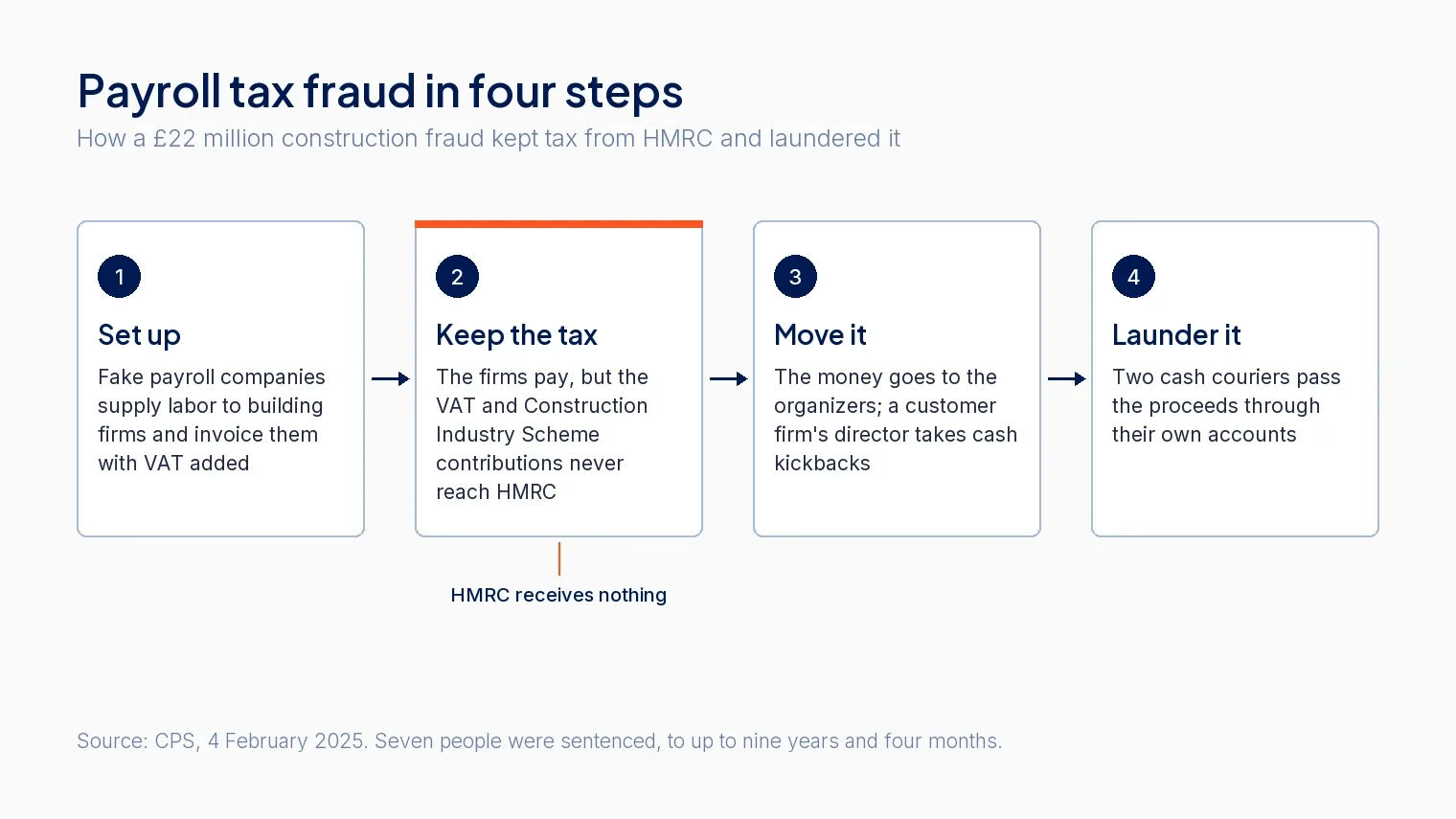
On 4 February 2025, seven people were sentenced, to up to nine years and four months, for a £22 million construction fraud (CPS, 4 February 2025):
- Set up. Fake payroll companies supplied labor to building firms and invoiced them with VAT added.
- Keep the tax. The firms paid, but the VAT and Construction Industry Scheme contributions never reached HMRC.
- Move it. The money went to the organizers; a customer firm's director took cash kickbacks.
- Launder it. Two cash couriers passed the proceeds through their own accounts.
Other methods used by tax fraudsters include underreporting income, inflating expenses, fake charitable donations, stolen or invented Social Security numbers, offshore accounts and fake businesses.
Which types of tax fraud show up in recent cases?
Table 1. Seven tax fraud schemes, each with a public case.
| Type | How it works | Where it shows in account data | Public case |
|---|---|---|---|
| Income tax evasion | Income left off the return | Personal spending paid from company accounts | A business owner charged with paying tens of millions of dollars in personal expenses from company funds and not reporting them as income (DOJ, 14 October 2026) |
| False deductions and credits | Invented expenses, donations or credits | Refund claims out of line with the business | Nearly $1.3 million in pandemic tax credits claimed on fictitious wages (IRS CI, 2025) |
| Offshore tax evasion | Assets held abroad and not declared | Wires to undeclared foreign accounts | Credit Suisse: over $4 billion in at least 475 accounts (IRS CI, 2025) |
| Employment tax fraud | Payroll tax withheld or never paid; workers paid under the table | Wages paid, no tax payments | A $177 million payroll tax scheme in construction; four years in prison (IRS CI, 2025) |
| VAT fraud | VAT collected and kept, or offset with fake trade | Trade that does not fit the business | £20 million offset fraud with fake Voice over Internet Protocol airtime, January 2011 to March 2014 (CPS, 20 October 2025) |
| Refund fraud in other people's names | Filing false returns to collect refunds | Many Treasury refund checks in different names paid to one party | Three men charged; the indictment alleges the three co-conspirators and others cashed over 16,000 refund checks worth over $74 million (DOJ, 14 October 2026) |
| Abusive tax shelters | Sham deals sold to create deductions | Large fees to promoters | About $14 million in false conservation easement deductions sold, a $4.8 million tax loss (IRS CI, 2025) |
For offshore cases, FATCA makes foreign banks report accounts held by US taxpayers. In the UK, "criminal attacks", organized and systematic attempts to defraud the tax system, were 8 percent of the tax gap in 2024 to 2025 (HMRC, chapter 7).
What are the red flags of tax fraud?
Tax fraud detection starts with the gap between declared income and account flows. The IRS lists the same signs: "bank deposits from unexplained sources substantially exceeding reported income" and documents "that appear to be altered or false" (IRM 25.1.1.4).
Table 2. Red flags of tax fraud in account data.
| Red flag | Data that shows it | Who acts |
|---|---|---|
| Deposits far above declared income | Declared income or turnover against 12 months of credits | KYC analyst, at the risk rating review |
| Cash heavy deposits in a card based business | Cash share of credits against peers | Transaction monitoring analyst |
| Wages paid, no tax payments | Payroll debits with no payments to the IRS or HMRC | Analyst, then the MLRO |
| Refunds in other people's names | Payee names that differ from the account holder | Fraud team holds; MLRO decides on a report |
| Transfers to undeclared foreign accounts | Cross border wires to accounts never disclosed | MLRO |
| Altered or inconsistent documents | Names, addresses or tax numbers that do not match | KYC analyst |
| News of tax crime | Adverse media on owners or directors | Screening analyst |
Picture a cleaning company that declares £150,000 in turnover while its account takes in £420,000 a year. The first row fires; at the next review the analyst can check the owner's name for tax crime news.
How do you avoid tax fraud and tax scams?
The IRS warns taxpayers that "even if someone else prepares your return, you are ultimately responsible for all the information on the tax return" (IRS tax fraud alerts). Scammers pose as the IRS to get money or personal details (IRS guidance on tax scams).
Firms prevent it with written Criminal Finances Act procedures and a monthly payroll tax check. Banks comparing fraud detection solutions can start from how fraud detection works.
What are the penalties for tax fraud in the US and UK?
Table 3. Maximum penalties for tax fraud by jurisdiction.
| Rule | What it covers | Maximum |
|---|---|---|
| US: 26 U.S.C. 7201 | Attempt to evade or defeat a tax (felony) | 5 years; fine $100,000 ($500,000 for a company) |
| US: 26 U.S.C. 7206 | False return or document (felony) | 3 years; fine $100,000 ($500,000 for a company) |
| US: 26 U.S.C. 7203 | Willful failure to file or pay (misdemeanor) | 1 year; fine $25,000 ($100,000 for a company) |
| US: 26 U.S.C. 6663 | Civil fraud penalty | 75% of the underpayment due to fraud |
| UK: cheating the public revenue | Common law fraud on HMRC | Life imprisonment (Sentencing Council) |
| UK: Taxes Management Act 1970, s106A | Fraudulent evasion of income tax | 14 years (7 for offenses before 22 February 2024) |
| UK: VAT Act 1994, s72 | Fraudulent evasion of VAT | 14 years (7 for offenses before 22 February 2024) |
| UK: Criminal Finances Act 2017, s45 | A company fails to prevent an associate facilitating UK tax evasion | Unlimited fine |
Consequences in court sit well below these maximums, even though a person's fine for a federal felony can reach $250,000 under 18 U.S.C. 3571. In fiscal year 2025, 324 US federal cases involved tax fraud; the average sentence was 17 months and 68 percent went to prison (US Sentencing Commission). The UK revenue fraud guideline sets an offense range of 3 to 17 years for cheating the public revenue.
Is tax fraud a felony?
In the US, yes: evasion (section 7201) and a false return (section 7206) are felonies, while willful failure to file (section 7203) is a misdemeanor. UK law has no felony class; its statutory tax fraud offenses carry up to 14 years.
How do you report tax fraud?
Use Form 3949-A to report tax fraud to the IRS, anonymously if you prefer, or Form 211 to claim a whistleblower award (IRS report page). Awards are generally 15 to 30 percent of what the IRS collects (IRS Whistleblower Office).
In the UK, HMRC takes reports online and may pay a reward when one leads it to recover over £1.5 million (HMRC's report page). Inside a firm, staff go to the MLRO, who decides on a suspicious activity report.
Why does a bank's AML program care about tax fraud?
Evaded tax can sit in a customer's account. In the UK it is criminal property under section 340 of the Proceeds of Crime Act 2002, and section 330 makes a regulated firm's failure to disclose a suspicion an offense. In the US, 18 U.S.C. 1956 covers moving the proceeds of a listed crime with intent to evade tax or file a false return (sections 7201 and 7206). Banks report any transaction of $5,000 or more they suspect hides illegal funds "as part of a plan to violate or evade any Federal law" (31 CFR 1020.320).
Under section 45 of the Criminal Finances Act 2017, a firm whose employee or other associate helps a customer evade UK tax commits an offense unless it had reasonable prevention procedures. Section 46 covers foreign tax.
It moves by the same money laundering methods as other proceeds.
In fiscal 2025, 70.8 percent of the US Trustee Program's bankruptcy fraud referrals alleged tax fraud, mostly improper filing status and misused exemptions; allegations overlap.
The whitepapers on AML in the United States and AML in the United Kingdom set out each country's wider rules.
complead, formerly Sanction Scanner, puts onboarding, screening, monitoring, fraud and investigation on one engine. Each customer gets a single risk score.
Related terms
- Predicate offense. A crime whose proceeds can be laundered; in the UK, tax evasion is one.
- Embezzlement. Theft by someone trusted with the funds.
- Benefit fraud. False claims for state benefits.
- Fraud vs money laundering. Making criminal money against hiding it.
Three things to do this week:
- Add tax crime to your adverse media categories for cash heavy segments.
- Compare payroll clients' deposits with their declared turnover.
- Check that your Criminal Finances Act procedures are written and dated.