One Paycheck Protection Program (PPP) case in three dates (US Attorney's Office, Western District of Missouri):
- 14 May 2020: Mark Crosby applies for a $71,417 PPP loan for Crosby Auto LLC, stating a monthly payroll of $28,567 the company did not have.
- 2 June 2020: $71,400 reaches Crosby Auto's bank account.
- 23 April 2026: he pleads guilty to wire fraud over two PPP loans totaling $92,233.32.
Of the forms fraud takes, loan fraud is the one aimed at a lender's credit decision.
What are the types of loan fraud?
The types differ by who lies and whose identity is on the application: the borrower, an insider, a stranger or a person who does not exist. In the advance fee scam, the "lender" is the fraudster.
Table 1. Nine types of loan fraud.
| Type | Who lies, to whom | Example or figure |
|---|---|---|
| Mortgage loan fraud | A borrower or an insider, to a home lender | False employment, income or appraisal figures on a home loan (FHFA) |
| First party fraud | The borrower, in their own name, about income, job, debts or intent to repay | A personal loan taken with an edited payslip (Table 2); Cifas counts false applications among first party frauds (Fraudscape 2026) |
| Second party fraud | Someone close to the victim, or the lender's own staff, using their access | Staff who misreport a customer's salary to secure a loan, a case of employee fraud |
| Third party fraud | A stranger, in a stolen identity | 176,400 US loan or lease identity theft reports in 2024, third among identity theft types (FTC Data Book, March 2025); 14,220 loans identity fraud cases filed with Cifas in 2025 |
| Synthetic identity fraud | An applicant built from real and invented personal details | A name, birth date and ID number that belong to no single person (see the next section) |
| Loan stacking | The borrower, to several lenders at once | Several loans in a short window, none disclosed to the others (below) |
| Straw borrower | A person who applies in their own name for someone else | On a home loan, FHFA's straw buyer "falsely appears as the mortgage applicant" while acting for another person |
| Business loan fraud | An owner, about payroll, revenue or the company itself | Crosby's false monthly payroll of $28,567 (below) |
| Advance fee loan scam | A fake lender, to the borrower | A promised loan, a fee for "processing" or "insurance", then no loan and no lender (FTC) |
What is loan stacking, and is it a crime?
Loan stacking is taking several loans from different lenders in a short window, so each lender decides without knowing about the others. Even several loans taken at once break none of the laws on this page; leaving them off an application that asks about existing debts is a false statement.
Cifas tied a 22 percent rise in evasion of payment filings in 2025 to applications "with no intent to repay" (Fraudscape 2026).
What does business loan fraud look like, from SBA loans to PPP?
Business loan fraud puts false payroll, revenue or company details on an application for a bank or government backed loan. The SBA's Office of Inspector General estimated that the agency disbursed "over $200 billion in potentially fraudulent" pandemic disaster loans, advances and PPP loans, "at least 17 percent" of those funds (SBA OIG, 27 June 2023).
What does loan fraud mean, and what does it not cover?
In US federal law, 18 U.S.C. 1014 punishes anyone who "knowingly makes any false statement or report" to influence a listed lender, from FDIC insured banks and insured credit unions to "a mortgage lending business". In England, Wales and Northern Ireland, section 2 of the Fraud Act 2006 covers a dishonest false representation, including one "submitted in any form to any system or device", such as an online form.
Borrowing in good faith and then failing to repay leaves a debt, and none of the offenses on this page punishes the missed payment. Section 2 does count a representation about a person's "state of mind", so a promise to repay that the borrower never meant to keep can be a false representation.
"Under 18 U.S.C. 1014 the offense is the false statement, made 'for the purpose of influencing' the lender, and since United States v. Wells in 1997 prosecutors have not had to prove the lie was material," says Ufuk Gürdaş, Compliance Specialist.
How is loan fraud different from mortgage fraud and synthetic identity fraud?
Mortgage fraud is loan fraud on a home loan. FHFA characterizes it by "a material misstatement, misrepresentation, or omission" that a lender then relies on. Fraud for profit "usually involves industry insiders"; fraud for housing is borrowers acting illegally "to acquire or maintain ownership of a home".
Synthetic identity fraud is about who applies. A Federal Reserve focus group defines it as "the use of a combination of personally identifiable information (PII) to fabricate a person or entity" (FedPayments Improvement). Selling land you do not own is land fraud.
How does one fraudulent loan application get approved?
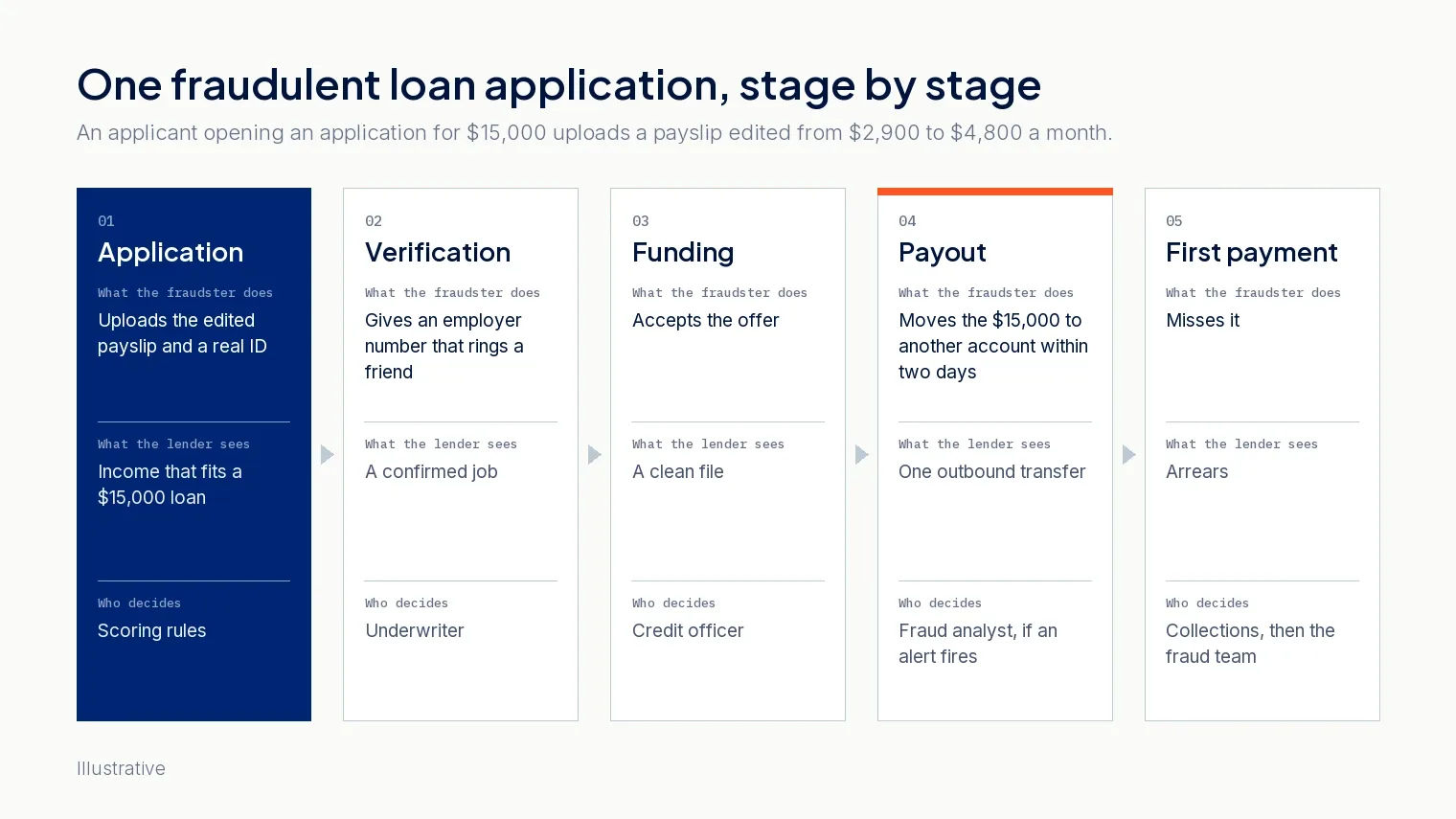
Picture an online lender that pays out personal loans of up to $20,000 without a phone call. An applicant opening an application for $15,000 uploads a payslip edited from $2,900 to $4,800 a month.
Table 2. One fraudulent loan application, stage by stage (illustrative).
| Stage | What the fraudster does | What the lender sees | Who decides |
|---|---|---|---|
| 1. Application | Uploads the edited payslip and a real ID | Income that fits a $15,000 loan | Scoring rules |
| 2. Verification | Gives an employer number that rings a friend | A confirmed job | Underwriter |
| 3. Funding | Accepts the offer | A clean file | Credit officer |
| 4. Payout | Moves the $15,000 to another account within two days | One outbound transfer | Fraud analyst, if an alert fires |
| 5. First payment | Misses it | Arrears | Collections, then the fraud team |
Every check here tested the file against itself. Nobody compared the payslip with the salary credits on a bank statement, and nobody looked the employer up.
If the file is never reopened at stage 5, the loss is booked as bad debt, not fraud, and the same payslip can pass at the next lender.
Which red flags should a lender check before funding?
Loan application fraud detection starts before the money leaves. Seven checks:
- False bank statements, wage slips or ID documents. Cifas members still see them supporting loan, bank account and asset finance applications (six month update, August 2026).
- The same document on more than one application. Cifas members report fake documents "reused repeatedly across multiple applications" (Fraudscape 2026).
- An address the applicant left off. In Cifas data for 2025 bank account applications, undisclosed adverse addresses were the most common reason for false application filings, 46 percent of cases.
- A personal loan with deferred repayments. Loan identity fraud filings rose 49 percent to 10,604 in the first half of 2026, "largely driven by personal loans with deferred credit" (same update).
- Undeclared credit from other lenders, the stacking pattern.
- Employment only the applicant vouches for. FHFA counts employment misrepresented to make a borrower "appear more financially qualified for the loan" as a fraud type.
- Fraud news on the business or its owner. Check a borrower or business for fraud news before funding.
Which laws make loan fraud a crime, and what are the penalties?
Table 3. Loan fraud offenses and maximum penalties, US and UK.
| Rule | What it covers | Maximum, as the text states |
|---|---|---|
| US: 18 U.S.C. 1014 | A knowingly false statement to influence a listed lender | $1,000,000 fine, 30 years, or both |
| US: 18 U.S.C. 1344 | Executing a scheme to cheat a financial institution, or to obtain its money or property by false or fraudulent pretenses | $1,000,000 fine, 30 years, or both |
| US: 18 U.S.C. 1343 | Wire fraud, such as a false application sent online | A fine, 20 years, or both; $1,000,000 fine, 30 years, or both if it affects a financial institution or involves a benefit tied to a presidentially declared major disaster or emergency |
| US: 16 CFR 310.4(a)(4), Telemarketing Sales Rule | A seller or telemarketer asking for a fee before a loan is obtained, after guaranteeing or representing a high likelihood of success | No penalty in the section; it names the practice abusive and a violation of the rule |
| UK: Fraud Act 2006, s1 | Fraud by false representation (s2), by failing to disclose information (s3) or by abuse of position (s4) | On indictment, up to 10 years, a fine, or both; the Act extends to England, Wales and Northern Ireland only (s15) |
In the US, a 30 year maximum makes 1014 and 1344 Class B felonies, and wire fraud's 20 years a Class C felony, under 18 U.S.C. 3559.
Who catches loan fraud?
Cases surface in four places: the lender's own fraud and AML checks at origination; shared fraud data such as the UK's Cifas National Fraud Database; law enforcement, as when IRS Criminal Investigation investigated Crosby; and the victim, because accounts in your name that you do not recognize "could be a sign of identity theft", the FTC says.
The SBA's inspector general, with SBA, the US Secret Service, other federal agencies and financial institutions, has seen nearly $30 billion in pandemic loan funds seized or returned to SBA (SBA OIG, June 2023).
A loan application that denies a bankruptcy is a sign of bankruptcy fraud too: a Puerto Rico debtor whose Paycheck Protection Program application denied his bankruptcy got 18 months.
To help lenders link the application to what happens after payout, complead, formerly Sanction Scanner, scores a borrower once: onboarding, screening, monitoring, fraud and investigation, bank transaction fraud monitoring included, run on one engine.
How do lenders prevent loan fraud?
Lending fraud prevention takes four controls:
- Check documents at the source: the payslip against the salary credits.
- Search shared fraud data before funding.
- Keep watching the account after payout, where stage 4 happens.
- Screen business borrowers, their directors and beneficial owners.
See onboarding and monitoring checks for lenders, and the guide on how fraud detection works.
What should you do if someone took out a loan in your name?
The FTC's steps for the US:
- Report it at IdentityTheft.gov for a free recovery plan.
- Freeze your credit at Experian, TransUnion and Equifax; it is free, and nobody can open a new credit account while it holds.
- Place a fraud alert, so businesses check with you before opening a new account in your name.
- Check your credit reports for accounts you do not recognize.
If you paid a fee to a fake lender, the FTC asks you to report it at ReportFraud.ftc.gov.
A lie about the home itself, its value or whether the buyer will live in it, makes the case mortgage fraud, the subject of the next entry.
Related terms
- Mortgage fraud. Loan fraud on a home loan.
- Synthetic identity fraud. Borrowing as a person assembled from real and invented details.
- Identity fraud. Opening an account or taking credit in another person's name.
- Money mule. Someone whose own account carries criminal money onward.