
An examiner can test a firm's defenses against fraud by staff with two questions: who can both set up a payee and pay it, and when that person last spent two consecutive weeks away from every system. The FCA's Financial Crime Guide, FCG 4.2.1, counts "enhanced vetting and closer scrutiny" of staff in high risk positions as good practice.
Which schemes count as employee fraud, and what do they cost a business?
Table 1. Common types of employee fraud (ACFE, Occupational Fraud 2026: A Report to the Nations, 2,402 cases, pages 12 and 15). The last column is the author's practice note, not an ACFE finding.
| Scheme | What the employee does | Share of cases | Median loss | A control that targets it (practice note) |
|---|---|---|---|---|
| Theft of noncash assets | Takes stock, equipment or confidential customer data | 23% | $75,000 | Stock counts by someone else; data access logs |
| Billing | Bills the employer through a fake vendor or with inflated invoices | 21% | $90,000 | Vendor setup kept apart from payment approval |
| Expense reimbursements | Files false or inflated expense claims | 13% | $36,000 | Claims approved by someone outside the claimant's team |
| Check and payment tampering | Forges, alters or diverts a payment the employer makes | 10% | $114,000 | Two signatures; callbacks on bank detail changes |
| Payroll | Claims unworked overtime or pays a ghost employee | 10% | $63,000 | Payroll matched to HR records by a second person |
| Skimming (cash, not card) | Pockets a customer payment before it is recorded | 9% | $45,000 | Sales reconciled to receipts by someone else |
| Cash larceny | Takes recorded cash or checks before the deposit | 8% | $45,000 | Daily deposit reconciliation |
| Corruption | Takes a bribe or hides a conflict of interest in a deal , as in procurement fraud | 45% | $150,000 | Conflict of interest declarations |
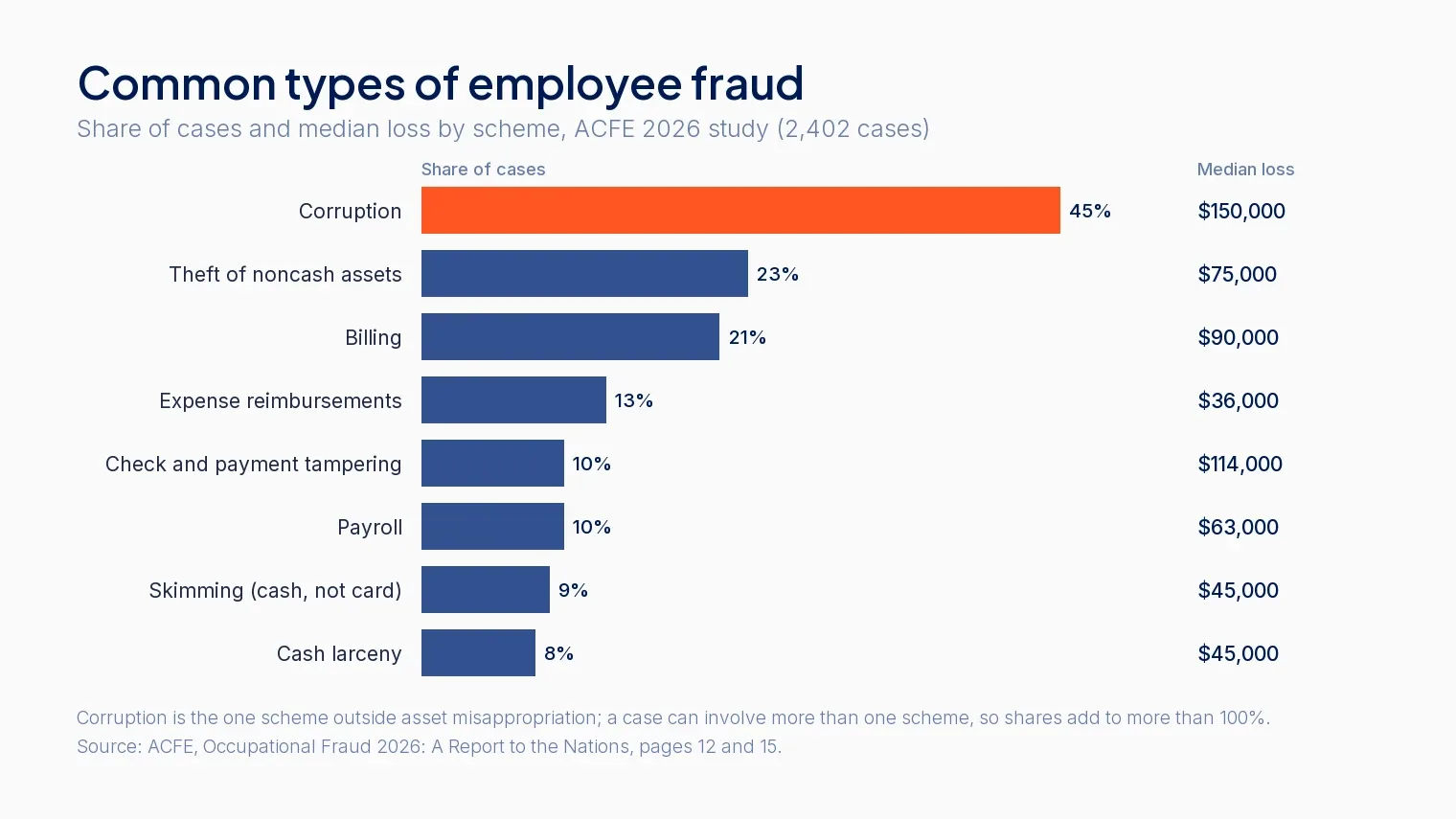
Every row except corruption is asset misappropriation in ACFE terms, and the shares add up to more than 100 percent because one case can mix schemes.
Embezzlement, taking money or property you were trusted to hold, describes several of these rows.
"A leave policy only catches fraud when the person is locked out of the systems and somebody else does the work for two full weeks, which is what the Federal Reserve has asked of banks since 1996; a vacation with remote access tests nothing," says Ufuk Gürdaş, Compliance Specialist.
How much does employee fraud cost a business?
Examiners in the ACFE study estimate that organizations lose 5 percent of revenue to fraud each year; its median loss was $104,000, and a typical scheme ran 12 months before detection (page 4). Businesses under 100 staff lost most, a median $126,000 (page 32). Wider trends are in the 2025 to 2026 Financial Crime and Compliance Report.
What does employee fraud mean?
The ACFE's term for employee fraud is occupational fraud: "the use of one's occupation for personal enrichment through the deliberate misuse or misapplication of the employing organization's resources or assets" (2026 report, page 106). Its Fraud 101 page files it under internal organizational fraud, where "an employee, manager or executive of an organization deceives the organization itself".
In England, Wales and Northern Ireland, the law reaches it as fraud by abuse of position. Section 4 of the Fraud Act 2006 covers anyone "expected to safeguard, or not to act against, the financial interests of another person". Its Explanatory Notes quote "employee and employer" as one such tie, and an omission can count.
Staff fraud and fraud in the workplace are other names for it. Employee theft is narrower. Take a warehouse clerk who sells stock and logs it as damaged: the stock is the theft, the false record is the fraud.
Is employee fraud a crime in the UK, the US and Türkiye?
Table 2. Employee fraud in criminal and banking law (sources read 18 October 2026).
| Country | Law | Who it covers | Penalty or effect |
|---|---|---|---|
| UK (England, Wales and NI) | Fraud Act 2006, section 4, fraud by abuse of position | Anyone trusted with another person's financial interests | Up to 10 years or a fine (section 1) |
| US | 18 U.S.C. 656 | Bank officers and employees who embezzle or misapply funds | Up to a $1,000,000 fine and 30 years; one year if $1,000 or less |
| US | 12 U.S.C. 1829 | Anyone convicted of a dishonesty or breach of trust offense | No work at an insured bank without the FDIC's written consent |
| US | SOX section 404, 15 U.S.C. 7262 | Listed companies | Annual management report on internal control over financial reporting |
| Türkiye | Turkish Penal Code No. 5237, article 155(2), breach of trust | Goods entrusted through a job, trade or service relationship | 1 to 7 years and up to 3,000 days' judicial fine |
| Türkiye | Banking Law No. 5411, article 160, embezzlement | Bank board members and other bank staff | 6 to 12 years, up to 5,000 days' fine, and the bank's loss repaid |
The UK and Türkiye charge employee fraud as fraud or breach of trust, and US federal law adds rules for banks. For Türkiye's wider regime, see AML rules in Türkiye.
The UK also covers the reverse case. When an employee commits fraud intending to benefit a large organization, the organization is guilty of an offense under section 199 of the Economic Crime and Corporate Transparency Act 2023, in force from 1 September 2025, which the Serious Fraud Office can prosecute. Reasonable prevention procedures are a defense.
Employers fired 75 percent of staff level perpetrators. Across all cases, 54 percent went to law enforcement, and 48 percent of defendants pleaded guilty or no contest while 24 percent were convicted at trial (ACFE, pages 74 and 75).
How does employee fraud happen, and what are its three steps?
Picture an accounts clerk with overdue school fees, sole control of the vendor file and a belief that the firm owes them unpaid overtime. Those details are the three sides of the fraud triangle.
The ACFE credits the triangle to Donald Cressey, a criminologist who studied embezzlers, and says a person with all three is "highly likely" to commit fraud:
- Unshareable financial need. A debt, a habit or a target the person cannot admit.
- Perceived opportunity. A control gap visible from inside the job.
- Rationalization. The story that makes it feel acceptable, such as calling the money a loan.
The employer can close only the second. In the ACFE data, 34 percent of employee frauds came down to missing internal controls and 20 percent to an override of existing ones (page 50).
What is an example of employee fraud?
The Explanatory Notes to the Fraud Act 2006 give two, in paragraphs 21 and 22. In one, an employee lets a contract go to a rival company at the employer's expense, which is fraud by omission. In the other, a software company employee clones its products to sell them on. The FCA's guide adds a salesman who misreports a customer's salary to secure a loan.
What are the red flags of employee fraud?
The ACFE saw at least one behavioral red flag in 84 percent of cases (page 68). The most common:
- Living beyond means (39 percent). Spending the salary cannot explain.
- Financial difficulties (29 percent). The need side of the triangle.
- A close tie to a vendor or customer (17 percent). Before paying, check a vendor's name for fraud news.
- Control issues and unwillingness to share duties (12 percent). Nobody else sees the work.
- Refusal to take vacations. Among the flags tied to the longest frauds, 18 months at the median (page 71).
Missing or altered invoices, receipts and approvals are the record side, and reconciliations are where they surface. No behavioral flag showed in 16 percent of cases.
What is the difference between employee fraud, management fraud and insider fraud?
Table 3. Occupational fraud by the perpetrator's position (ACFE 2026, pages 50, 52 and 53).
| Position | Share of cases | Median loss | Median duration | Top control weaknesses |
|---|---|---|---|---|
| Employee | 41% | $50,000 | 8 months | Lack of internal controls (34%); override (20%) |
| Manager | 41% | $125,000 | 14 months | Lack of internal controls (28%); override (19%) |
| Owner or executive | 16% | $475,000 | 23 months | Lack of internal controls (28%); override and poor tone at the top (20% each) |
Employee fraud in the narrow sense is fraud by staff without management authority. Management fraud is the same abuse by managers and executives up to the CEO, and their schemes run longer and cost more. Insider fraud is the wider label for fraud from inside a firm at any level, and the FCA uses it in its guide.
How do businesses identify and prevent employee fraud?
These five controls identify or prevent employee fraud; how fraud detection works covers them in depth.
- Reporting channels. Tips exposed 43 percent of frauds, and 55 percent of tips came from employees (page 23).
- Four eyes. No one person both sets up a payee and pays it.
- Required absence. Two consecutive weeks away, access cut, work covered (Federal Reserve SR 96-37); 8 percent of small firms use job rotation or mandatory vacation, against 32 percent of larger ones (page 44).
- Vetting, with a limit. Know your employee (KYE) checks screen out known offenders, but 88 percent of perpetrators had never been charged or convicted (page 66).
- Data checks. Vendor bank details matched against payroll and HR records, plus know your transaction (KYT) monitoring of outgoing payments, catch ghost vendors and employees.
The employee fraud detection market sells software for that last control. Fraud by customers is a different job. For that work, complead, formerly Sanction Scanner, gives each customer one risk score from a single engine that runs onboarding, screening, monitoring, fraud and investigation.
Each firm still has to decide which posts get the two week lockout and who covers the work.
Related terms
- Embezzlement. Taking money or property you were trusted to hold.
- Insider fraud. Fraud from inside a firm, at any level.
- Certified Fraud Examiner (CFE). The ACFE's fraud investigation credential.
- Know your employee (KYE). Staff checks at hiring and during employment.
- AML compliance officer. The person who owns a firm's AML program and trains staff to escalate red flags.
- Payroll fraud. False pay claims or ghost employees.