A study guide that lists four CFE exam sections describes the old exam. The version launched on 2 June 2026 has three (CFE Exam Candidate Handbook, June 2026, pages 8 and 24); Table 3 maps the old names.
Table 1. The CFE at a glance (ACFE pages, read 18 October 2026).
| Item | Rule |
|---|---|
| Awarding body | ACFE, Austin, Texas, USA; no other body awards the CFE |
| Membership | Associate Member of the ACFE |
| Eligibility points | 40 to sit the exam, 50 to be certified |
| Experience | Two years in a fraud related field |
| Exam | Three sections, 310 questions, 6.5 hours |
| Pass mark | 75% in each section |
| Application fee | $480 |
| Upkeep | Dues (vary by country) and 20 CPE credits a year |
What is the Certified Fraud Examiner (CFE) certification?
The CFE certification is the ACFE's credential in fraud examination. The ACFE describes CFEs as "trained professionals who possess a unique set of diverse skills in preventing, detecting and investigating fraud" (ACFE, CFE credential). The association has more than 100,000 members in over 180 countries (ACFE, Who We Are), is the only body allowed to award the CFE and says the credential is recognized worldwide (CFE FAQs).
The certification is important because one exam covers the whole life of a case. Picture an auditor who finds 14 invoices from a supplier with no delivery records: a CFE is trained to trace the payments, interview the clerk and write up the evidence.
What does CFE stand for?
CFE stands for Certified Fraud Examiner, a professional designation and qualification. Holders put the letters after their name. Each new CFE gets a Credly digital badge that anyone can verify online, and a printed certificate on request (Candidate Handbook, page 9).
Who needs a CFE, and what are the benefits?
Anyone who prevents, detects or investigates fraud. The ACFE accepts eight kinds of fraud related experience (ACFE eligibility), each matching a seat:
- Accounting and auditing: auditors testing records and controls.
- Compliance and ethics: compliance officers, the AML compliance officer among them.
- Corporate security and loss prevention: asset protection.
- Fraud investigation: investigators and police officers who collect evidence and trace assets for the victims of fraud.
- Fraud prevention and fraud risk management: control owners.
- Legal services, litigation support and consulting: lawyers and the forensic consultants who support them in fraud cases.
- Proactive fraud detection: analysts who monitor payments and screen counterparties.
- Teaching, writing or research: trainers and academics.
On the advantages of using a CFE, the ACFE says organizations with CFEs on staff uncover fraud 38 percent sooner, with losses 62 percent smaller; it cites "ACFE research" and publishes no method (CFE benefits).
What are the CFE requirements and prerequisites?
Take the ACFE's own example. A candidate who attended college full time for two years earns 20 points and, in the ACFE's words, still needs "an additional four years of professional experience to meet the education requirements" (ACFE eligibility page). Without a degree, two years of fraud related experience can stand in for each year of study.
Table 2. CFE eligibility points (Candidate Handbook, June 2026, page 5).
| Source of points | Points |
|---|---|
| Bachelor's degree or higher | 40 |
| Associate degree | 20 |
| College study without a degree | 10 per academic year |
| 2 years of professional experience | 10 |
| 4 years | 20 |
| 6 years | 30 |
| 8 years | 40 |
| 10 years | 50 |
| An approved professional credential | 10 |
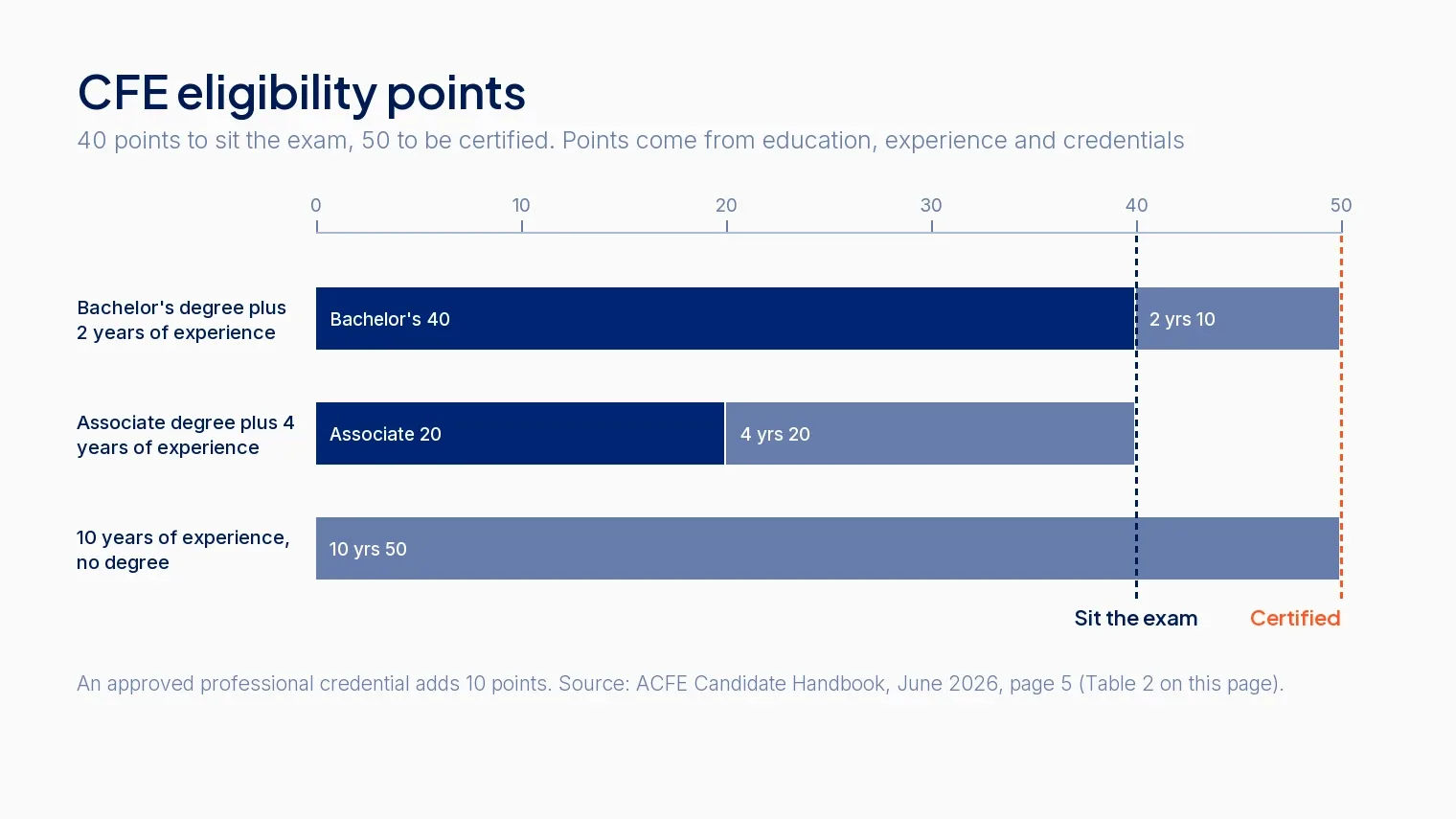
The full rule has five parts:
- Be an Associate Member of the ACFE.
- Hold 40 points to sit the exam and 50 to be certified.
- Have two years of fraud related experience by the time you certify.
- Pass the exam.
- Agree to the ACFE's Code of Professional Ethics.
A bachelor's degree plus two years of experience reaches 50 exactly.
Can you sit the exam before two years of experience?
Yes. A candidate with 40 points can take the exam and becomes a CFE on reaching 50 points and two years of experience. Passed results stay valid for five years from the last section passed (CFE FAQs).
What is covered on the CFE exam?
Table 3. The three CFE exam sections since 2 June 2026 (ACFE, About the CFE exam).
| Section | Questions | Time | What it covers | ACFE name before June 2026 (Handbook, page 10) |
|---|---|---|---|---|
| Fraud Schemes and Financial Crimes | 120 | 2.5 hours | Schemes, accounting basics, financial statement fraud, money laundering | Financial Transactions and Fraud Schemes |
| Fraud Investigations and Legal Issues | 120 | 2.5 hours | Evidence, interviews, data analysis, report writing, legal systems | Investigation; Law |
| Fraud Prevention and Deterrence | 70 | 1.5 hours | Why people commit fraud, governance, fraud risk assessment, ethics | Fraud Prevention |
Each section is a separate closed book exam of multiple choice and true or false questions, and the pass mark is 75 percent in each (how to earn your CFE). That per section bar is what makes it hard: a strong Section 1 cannot carry a weak Section 3. Candidates sit online with a live Prometric proctor or at a Prometric test center, get results within 24 hours and have five attempts per section (Candidate Handbook, page 8).
The exam is offered only in English, and the study materials carry translated key terms in seven languages (CFE exam FAQs).
Section 1 opens with accounting concepts, and corruption alone carries 7 of its 120 questions (Content Outline, May 2026, page 3).
How do you prepare for the CFE exam?
The ACFE offers three routes (how to earn your CFE): the self paced CFE Exam Prep Course, the three day CFE Exam Review Course, live or virtual, and the Fraud Examiners Manual, more than 2,000 pages and the source of everything the exam tests.
Then plan backwards. The application goes in at least 60 days before the first exam (Candidate Handbook, page 26). Once eligibility is activated, all three sections fall within a 60 day window, each booked about 30 days ahead (About the CFE exam). After the last pass, the final review takes about three weeks (Handbook, page 53).
What is the cost of becoming a CFE?
Table 4. CFE costs (ACFE prices, read 18 October 2026).
| Item | ACFE member | Non member | Source |
|---|---|---|---|
| Exam application, first attempt at each section | $480 | Members only | Handbook, p. 8 |
| Retake, per failed section | $110 | Members only | Handbook, p. 53 |
| One year extension of the two year application | $150 | Members only | CFE FAQs |
| CFE Exam Prep Course, one year | $899.20 to $1,699.20 | $1,124 to $2,124 | ACFE prep packages |
| Fraud Examiners Manual | $199.20 | $249 | ACFE Manual page |
| Review Course, Austin, 2 to 4 November 2026 | $2,745 (single listed price) | $2,745 | ACFE event page |
| Associate membership dues | Vary by country | Not applicable | ACFE dues calculator |
A member who studies from the Manual alone pays 480 plus 199.20 dollars, or 679.20 dollars before dues; the entry prep package in place of the Manual makes it 1,379.20 dollars.
After certification, a CFE pays annual dues and earns at least 20 CPE credits a year, 10 of them on fraud detection and deterrence and 2 on ethics (ACFE CPE requirements).
What is the CFE salary?
In 2024, CFEs with a four year degree reported earning 101,000 dollars a year, and the median for CFEs with a graduate degree was 112,000 dollars (ACFE Compensation Guide). The same guide puts the CFE premium over uncertified colleagues at 32 percent.
Those are survey answers: the guide's method note says Western Management Group emailed about 90,000 ACFE members in April 2024 and had 4,449 usable responses by the end of June, a 5 percent response rate.
Two limits follow. The uncertified comparison group is ACFE members, so analysts who never joined are missing. And the public page gives global figures with no split by country; the full guide is for members, and others can request it.
Does any law require a CFE?
No. The CFE is a voluntary credential rather than a license, and none of the fraud rules below names it. They ask organizations for procedures and people.
Table 5. Fraud rules by jurisdiction, and whether they name a CFE.
| Jurisdiction | Rule | What it asks | Names a CFE? |
|---|---|---|---|
| United Kingdom | Economic Crime and Corporate Transparency Act 2023, s199, from 1 September 2025 | A large organization is liable for fraud an associated person commits to benefit it, unless it had reasonable prevention procedures | No |
| United States | Sarbanes-Oxley Act s404 (15 U.S.C. 7262) | Management reports on internal control over financial reporting; the auditor attests | No |
| United States | 31 CFR 1020.210 | A bank AML program with internal controls, independent testing, training and a named compliance person, among other minimums | No |
| India | Companies Act 2013, s143(12) | Auditors report fraud above a prescribed amount to the Central Government | No |
The UK offense reaches only large organizations: section 201 counts one as large when, in the year before the fraud, it passed two of three lines (over 250 employees, over 36 million pounds turnover, over 18 million pounds balance sheet total). The Home Office guidance, updated 10 October 2025, describes reasonable procedures.
A CFE is one way to staff those procedures; how fraud detection works covers the systems behind them.
CFE vs CAMS or CFCS: which fits a fraud and AML team?
Say a payments firm sees one account take refunds from 30 stolen cards and move the money to a crypto exchange. An investigator builds the case file. The money laundering reporting officer (MLRO) decides whether to report it.
The CFE is built for the investigator: money laundering is 8 of the 120 questions in Section 1 (Content Outline, page 4). The MLRO's seat calls for an AML credential. CAMS, from ACAMS, is one: it needs 40 eligibility credits and an ACAMS membership, and the private sector package with the exam costs 2,095 dollars (ACAMS CAMS certification). It is set beside the CFE in AML certifications compared; ACFCS awards the CFCS (ACFCS certification overview).
Table 6. Who owns what in a fraud and AML team.
| Seat | Owns | Decides | Credential that fits the work |
|---|---|---|---|
| Fraud investigator | The case file and its evidence | Findings, never guilt (ACFE Code of Professional Ethics, item V) | CFE |
| Fraud prevention lead | Controls and the fraud risk assessment | Control design | CFE |
| AML analyst | Alert review and case notes | Whether to escalate | An AML credential, such as CAMS or CFCS |
| MLRO | The suspicious activity report | Whether to file | An AML credential |
Burçak Aydın, whose AML/CFT compliance work was at a bank and then a payment firm, describes the split from the examiner's side: "In a FRAML team the CFE usually owns the investigation file and the MLRO owns the decision to report, so an examiner reading the file expects the CFE's work papers to show the evidence behind each finding and never a view on guilt, which the ACFE's own code forbids."
Running fraud and AML on one platform, known as FRAML, puts both seats on the same customer record. If you are choosing a credential, start from the work you hold or want next: the case file points to the CFE, the reporting decision to an AML credential.
Related terms
- Fraud examination. The ACFE's body of knowledge: schemes, investigation, law and prevention.
- Occupational fraud. Fraud by employees against their employer.
- FRAML. Fraud and AML work run on one customer record.
- MLRO. The officer who decides whether a firm reports a suspicion.
- Serious Fraud Office (SFO). The UK prosecutor of serious or complex fraud, bribery and corruption.