
A dispute coded as fraud is not always chargeback fraud. A thief spending with stolen card data, then the cardholder's honest dispute, is credit card fraud. Europol's Operation Chargeback was that kind of case, despite its name.
Chargeback fraud, one of the types of fraud, is the real cardholder's false claim.
How does chargeback fraud work, from purchase to dispute?
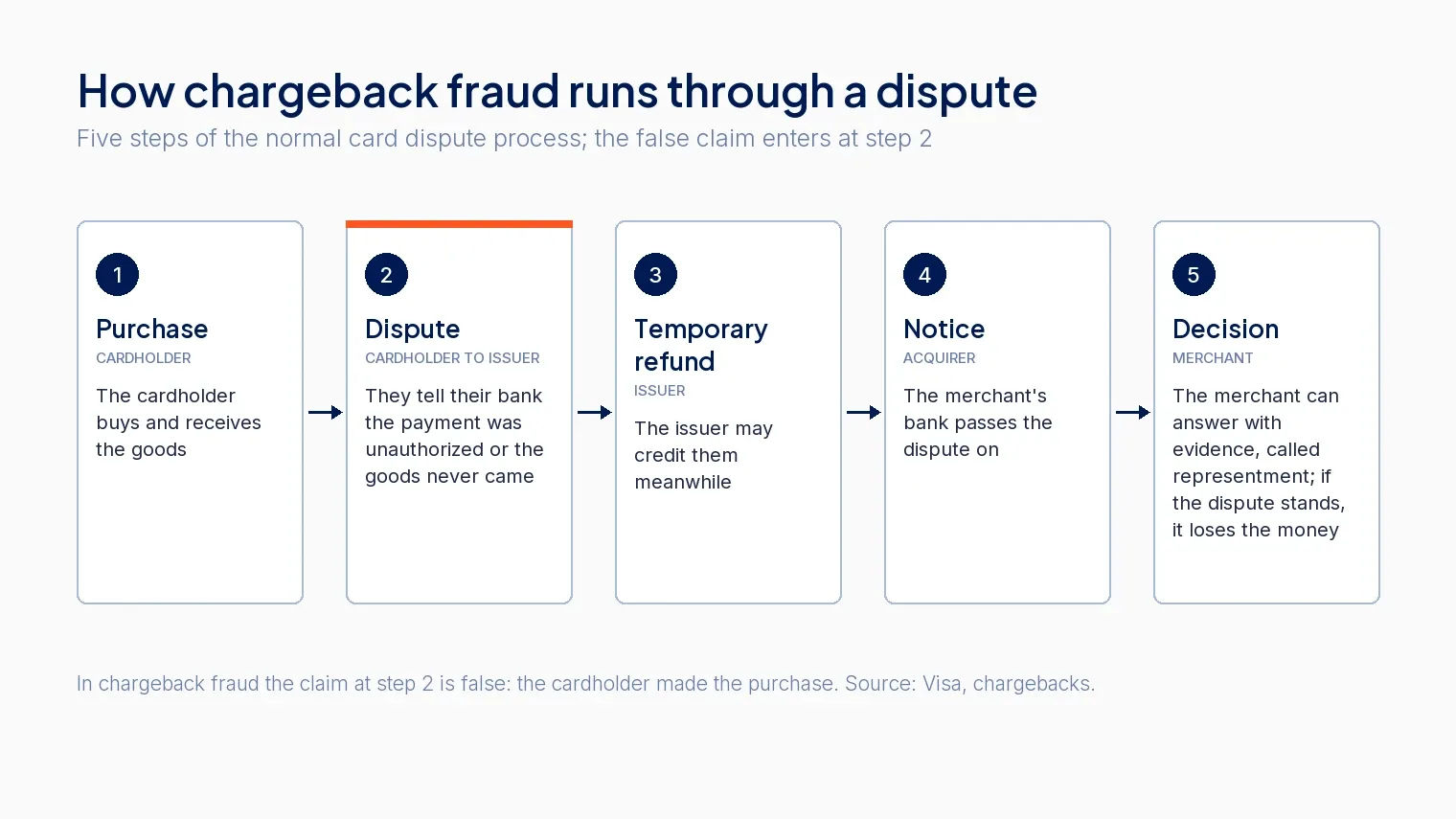
It runs through the normal dispute process (Visa):
- Purchase. The cardholder buys and receives the goods.
- Dispute. They tell their bank, the issuer, the payment was unauthorized or the goods never came.
- Temporary refund. The issuer may credit them meanwhile.
- Notice. The merchant's bank, the acquirer, passes it on.
- Decision. The merchant can answer with evidence, called representment. If the dispute stands, the merchant loses the money.
Picture a running shoe store whose $280 order was signed for at the door. Five weeks later the cardholder disputes it as fraud. The store holds two undisputed orders on the same card and device, five and nine months old.
From Burçak Aydın, author of this entry: "The evidence that wins a first party dispute has to be old enough: Visa's Compelling Evidence 3.0 generally counts earlier undisputed orders on the same card from more than 120 days and less than a year before, matched on the device ID or IP address and one more identifier, such as the login or the delivery address, so a merchant that deletes device logs after 90 days has nothing left to match."
Both of the store's orders fall inside that window (Visa Dispute Management Guide for Merchants, October 2026, p. 23).
What is a chargeback?
A chargeback, sometimes written charge back, is a card payment taken back from the merchant after the cardholder disputes it with their bank; Visa calls it a dispute (Visa guide, p. 2). Visa also lets one bank file for Compliance when another bank's rule breach cost it money and no dispute right applies (Visa Rules, 18 April 2026, section 11.12.1).
How does chargeback fraud affect businesses?
The merchant loses the goods and the sale, pays fees and spends staff time on the response (Visa). Merchants in Visa's 2025 survey put the average cost of resolving one first party dispute at $78, up from $74 (Visa Acceptance Solutions, 2025 Global eCommerce Payments & Fraud Report, p. 29). Higher chargeback ratios can trigger card network monitoring programs; altering merchant data to dodge Visa's Acquirer Monitoring Program can cost the acquirer USD 25,000 a month per merchant (Visa Rules, 12.5.3.2).
Chargeback fraud, friendly fraud or first party fraud: which is it?
Table 1. Chargeback fraud beside friendly fraud, first party fraud and card fraud.
| Term | Who files the dispute | Purchase made by the cardholder? | Intent | Who loses first |
|---|---|---|---|---|
| Chargeback fraud | The cardholder | Yes | A deliberate false claim | The merchant |
| Friendly fraud | The cardholder | Yes, or by someone in the household | Deliberate or accidental | The merchant |
| First party fraud | The account holder | Yes | Deliberate | The merchant |
| Card fraud, then an honest dispute | The cardholder, after a thief used the card | No | Honest | The merchant or the issuer |
| Merchant error | The cardholder | Yes, but billed wrongly | Honest | The merchant |
Visa gives chargeback fraud as another name for friendly fraud, though friendly fraud is "sometimes accidental". The definition turns on intent, along a spectrum from a forgotten subscription to a deliberate chargeback scam where the scammer keeps the goods. Fraudulent chargebacks after card theft fall outside it, as do "criminal fraud" and "triangulation fraud" when filed under chargeback scams: both run on someone else's card details, Visa's "genuine fraud".
What is first party fraud?
First party fraud, sometimes written 1st party fraud, is fraud committed by the account holder. Visa calls the card version first party misuse: a dispute over a purchase the cardholder or someone in their household made, unlike third party fraud with stolen credentials. Checks built for stolen cards miss it: the card, device and address are the customer's own.
Which orders point to a friendly fraudster?
No single signal proves it. These indicators, all from Visa, earn a second look:
- A first order on a new account. CE3.0 is less likely to apply to a first time purchase (Visa guide, p. 79).
- Earlier disputes on the account. Visa advises watching for them.
- Digital goods or subscriptions. Delivery is hard to prove.
- No contact before the dispute. The customer skipped the merchant.
- A saved card in a shared household. Someone else may have bought it.
- An unclear billing descriptor. Customers dispute names they do not recognize.
- A device or IP address unlike earlier orders. Visa advises checking both.
What causes chargeback fraud, and what types are there?
Picture a streaming subscriber who disputes a $12 charge as fraud because the statement name looks unfamiliar. Merchants in Visa's 2025 survey rank free goods as the most common cause, then descriptor confusion, amount confusion and late returns (p. 29). The types follow:
- Free goods. A false claim of non delivery or no authorization.
- Buyer's remorse. A regretted purchase disputed instead of returned.
- Household misuse. A child or partner used the saved card.
- Descriptor confusion. An unrecognized name on the statement.
- Subscription disputes. A renewal forgotten, or claimed as canceled.
- Return policy abuse. A dispute after keeping goods past the return window.
Is chargeback fraud still growing?
Yes, but it is no longer exploding. In Visa's 2025 survey, 62 percent of merchants saw first party misuse rise by 5 percent or more, but only 24 percent saw a rise of 25 percent or more, down from 31 (p. 27). Merchants blame customers who "game the system" and issuers that make disputes too easy (p. 8), and a third point to fraud sold as a service (p. 29). complead, formerly Sanction Scanner, covers the wider year in its Financial Crime and Compliance Report.
Which rules decide a chargeback dispute?
Table 2. Rules behind a chargeback dispute, by jurisdiction.
| Rule | Applies to | What it says | Who checks |
|---|---|---|---|
| US: Regulation Z, 12 CFR 1026.13 and 15 U.S.C. 1666 | Credit cards | Billing errors include charges the cardholder did not make and goods "not delivered ... as agreed"; notice within 60 days; resolved within two billing cycles, 90 days at most | Federal banking agencies, the CFPB and the FTC |
| US: Regulation E, 12 CFR 1005.11 | Debit cards | Notice within 60 days of the statement; investigation in 10 business days, or up to 45 days with provisional credit | Federal banking agencies, the CFPB and the FTC |
| UK: Payment Services Regulations 2017, reg 74 and reg 76 | Cards and payment accounts | Unauthorized payments reported within 13 months of the debit; refund by the end of the next business day, unless the provider suspects fraud and reports its grounds in writing | FCA |
| UK: Consumer Credit Act 1974, s75 | Credit card purchases over £100, up to £30,000 | The card issuer is jointly liable with the seller for misrepresentation or breach of contract | Courts |
| England, Wales and Northern Ireland: Fraud Act 2006, s2 | Anyone | Dishonest false representation for gain, including one made to "any system or device" | Police and prosecutors |
| US: 18 U.S.C. 1343 | Anyone | Wire fraud: a scheme to defraud carried out by wire; up to 20 years, or 30 if it affects a financial institution | Federal prosecutors |
| Visa: Compelling Evidence 3.0 | Card absent fraud disputes (Dispute Condition 10.4) | At least two earlier undisputed transactions, generally 120 to 365 days old, matching on device ID or IP address plus one more identifier such as login ID or delivery address, can answer the dispute | Visa, through the acquirer |
| Mastercard: First-Party Trust | Merchants in the United States | Historical data matched on device identity, delivery and one more identity factor; a match in each shifts liability | Mastercard |
The law grants the dispute right, a consumer protection, and sets the deadlines; card network and brand initiatives such as CE3.0 decide how issuer and merchant settle each case. The regulatory position differs by country. A false dispute can itself be a crime under the Fraud Act or the wire fraud statute.
How can merchants prevent chargeback fraud? Strategies by role
Visa says no practice guarantees disputes can be avoided (Visa guide, p. 84), so chargeback avoidance means reduction. Merchants hold most of the best practices: a recognizable billing descriptor, delivery proof, AVS and CVV anti fraud checks, order records, device and IP logs kept a year, and quick refunds. Acquirers watch dispute ratios and check a merchant or counterparty for fraud news at onboarding; a merchant processing another business's sales is transaction laundering. Issuers test a fraud claim against the account's history.
Payment fraud detection solutions keep each order's device history and decision signals as an evidence pack for chargeback management. For techniques, automated mitigation and internal controls, see how fraud detection works.
How do you fight a chargeback you believe is fraud?
Merchants deal with a suspected friendly fraud dispute through representment: evidence tied to the transaction by the card's last four digits, amount and customer details (Visa guide, p. 24). Visa's rules count transactions at other merchants as CE3.0 evidence for disputes from 24 October 2026, "to further reduce friendly fraud" (Visa Rules, p. 48). Mastercard's First-Party Trust offers US merchants a similar liability shift.
This week:
- Keep device and IP logs for 365 days.
- Read your billing descriptor on a real statement.
- List customers with two or more disputes this year.
Related terms
- Credit card fraud. Paying with someone else's card or card details.
- Card not present fraud. Card fraud on online, phone or mail orders.
- Ecommerce fraud. Fraud against online stores and shoppers.
- Return fraud. Abuse of a store's returns policy, without a bank dispute.